
Over the past week, Bitcoin has staged an extremely strong rebound, with a weekly gain exceeding 23% and prices peaking at $79,463, marking a new cyclical high since this summer.
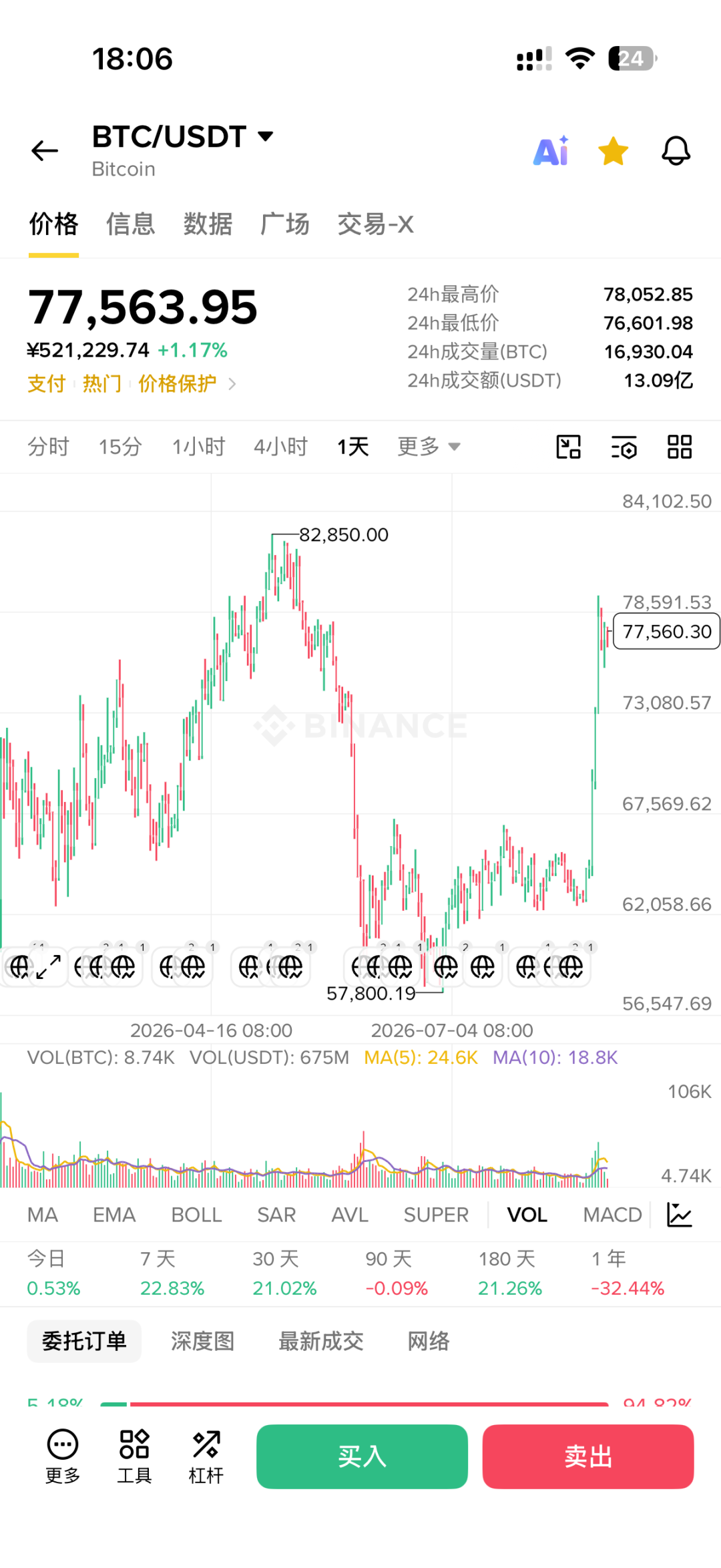
But if you look closely at the current macro environment, you'll see this rally defies conventional logic. The Middle East geopolitical situation remains tense, with no signs of easing in the US-Iran standoff, and geopolitical risks continue to push energy prices higher. On August 21, Brent crude briefly approached $94, reigniting inflation concerns across global markets. According to traditional trading logic—heightened geopolitical conflict, rising oil prices, and warming inflation expectations—risk assets should be under pressure and pull back. Yet reality tells a different story: Bitcoin has rebounded steadily from a low of $64,000, aggressively approaching the $80,000 mark. So everyone is pondering one core question: Is war actually a tailwind for Bitcoin, or has our understanding of the market always been too one-sided? Stop oversimplifying: Bitcoin isn't just a "war避险 asset." The biggest trap markets fall into is attributing this rally solely to "geopolitical safe-haven demand." Gold fits the war-safe-haven logic perfectly—it's a traditional hard currency, low volatility, stable store of value, and the first choice for capital seeking refuge in a crisis. But Bitcoin has never been a simple safe-haven asset. Those who truly understand cycles know that in the very first second of extreme panic, markets always sell risk and chase liquidity. In March 2026, when Middle East tensions escalated, Bitcoin dropped sharply in the short term; in mid-August, with renewed Iran tensions, BTC again fell to the $64,000 range. At the onset of war, Bitcoin is always bearish. The reason is straightforward: geopolitical conflict pushes energy prices up → inflation expectations rebound → markets reprice rate expectations → high-volatility risk assets are sold off first for cash. So, only fixating on the word "war" to judge price movements is bound to get it backwards. Markets aren't trading the war itself; they're trading the chain reaction it triggers: oil prices, inflation, rates, Treasuries, and dollar liquidity. This round of BTC's countertrend strength is essentially a precise resonance of three core forces. First: US Treasury liquidity expectations are reshaping global asset pricing. The most fundamental macro support for this rally comes from subtle shifts in the US Treasury market. The Treasury Department raised its buyback scale for long-term bonds, sending a clear signal: proactively easing liquidity pressure on long-dated debt and shoring up the Treasury market. This seemingly niche fiscal move directly altered global capital logic: Treasury yields fell → the dollar weakened → overall financial conditions loosened → global capital began hunting for yield-bearing assets. Following that, gold and Bitcoin rose in tandem. This isn't a war-safe-haven trade; it's a trade on the depreciation of dollar purchasing power. Capital is no longer just panicking over conflict; it's pricing in the reality of expanding dollar debt, currency dilution, and declining long-term purchasing power. As dollar credit continues to erode, Bitcoin and gold naturally become the core hedges against the dollar system. Second: The return of ETF institutional flows is the main driver of this rally. Retail traders watch candlestick movements; institutions watch capital flows. The hardest data backing this rebound comes from sustained net inflows into US spot Bitcoin ETFs. From Monday to Thursday last week, spot ETFs saw cumulative net inflows exceeding $1.6 billion; on August 20 alone, net inflows hit $606 million, one of the highest single-day records since May. During the earlier consolidation around $60,000, market sentiment was extremely pessimistic, with many declaring institutional capital had exited and crypto was dead. But the evidence shows: once the price trend repairs, institutional funds return immediately. Meanwhile, the market experienced an extreme short squeeze: prices kept rebounding → short positions faced pressure and liquidated → forced buybacks pushed prices higher → ETFs followed with continued accumulation → the trend strengthened further. Last week, over $4 billion in short positions across the crypto market were liquidated. Many assume this rally is driven by "retail frenzy," but the real incremental flows come from two sources: proactive institutional entry and passive buying from forced short covering. These are entirely different capital dynamics, and that's the core reason for the rapid price surge. Third: Extreme sentiment reversal is accelerating the upside as sidelined capital rushes in. Capital markets always cycle through the same truth: sentiment is crazier than price action. In just two weeks, sentiment across the board flipped 180 degrees. At the bottom around $60,000, everyone was bearish: "Buy the dip below $50,000," "The market is dead," "Uninstall the app and stop watching," "I'm giving up on crypto this year." But as prices broke $70,000 and approached $80,000, the tone shifted instantly: "I should have gone all-in at $60,000," "I'm so regretful for missing out," "Should I chase at $70,000?" "Looking at $80,000, $90,000, $100,000 new highs." Human nature never changes: fear at lows, greed at highs. At $60,000, everyone feared further declines; at $80,000, everyone fears missing out. The charts haven't changed, the market hasn't changed—only人心 and sentiment expectations have. Most people fail to make money not because opportunities don't exist, but because when they truly arrive, they lack the courage to position themselves. Bitcoin's positioning has long since broken out of the "niche circle game." Through this rally, we must recognize a fundamental shift: Bitcoin is no longer just a niche asset within a small community; it has truly entered the global macro asset pricing system. It moves with Treasury fluctuations, follows dollar strength, trends bullishly with ETF flows, reacts instantly to US regulatory changes, fluctuates with geopolitical conflicts, and quickly prices in policy and舆论 shifts. Over a decade ago, it was just an internet finance experiment; today, it stands at the center of the global capital chessboard. Some view it as digital gold, an inflation hedge; others see it as a tech-growth, high-odds risk asset; still others treat it as a new wealth vehicle outside the dollar system. The interweaving of multiple pricing logics means one thing: there will never be a simple linear causal relationship between war and Bitcoin's price moves. War is just one spark that disturbs the market; what truly determines direction is the ultimate flow of capital. After the $80,000 mark, don't guess at a bull market—just watch three core signals. The rapid 23% rebound has already maxed out short-term heat. At this stage, the most dangerous mindset is blindly calling for a bull run and insisting prices only go up. In capital markets, the phrase "always rising" has always been a top-signal warning. Beyond $80,000, there's no need to blindly predict $100,000 highs; focus on three key variables to understand the trend ahead: 1. ETF flow sustainability: Short-term moves rely on short covering; medium-to-long-term trends depend on external incremental capital. As long as ETFs see sustained net inflows, it signals long-term institutional recognition and continued absorption; once capital quickly turns to outflows, it means this rebound is just a short-term squeeze repair, and the market will likely return to consolidation. 2. Support strength at the $80,000 level: A wick touching $80,000 and holding above $80,000 are two entirely different concepts. True strength isn't about the highest point reached, but whether there's firm buying support after a pullback. 3. The hidden bearish factor of oil prices and inflation: The biggest risk from this geopolitical conflict is sustained high oil prices. Energy prices staying elevated will keep pushing inflation up and compress central banks' room for rate cuts. A persistently high-rate environment is a long-term drag on all risk assets. The realization of positives doesn't mean negatives have disappeared. Finally: The underlying lesson this rally teaches everyone. The rebound from $60,000 to $80,000 feels like a major market exam. After enduring liquidity tightening, extreme sentiment panic, geopolitical conflict-driven selloffs, and ETF capital outflows, Bitcoin still managed to recover quickly and rally strongly. This proves that the market's absorption capacity for Bitcoin is far stronger than retail investors imagine. But we must remain rational: don't equate geopolitical conflict directly with a Bitcoin positive; don't define a short-term rebound as the start of a super bull market. Debt, the dollar, liquidity, inflation, and capital—all these variables interact and ultimately determine price direction. The most valuable insight from this rally is just one sentence: When global capital begins to question dollar credit, the debt system, and currency purchasing power again, Bitcoin has long secured its seat at the center of the global core asset table. Beyond $80,000, there's no need for frenzy or anxiety. Don't rush to call a top, and don't blindly bet on new highs. Patiently watch capital flows—who's buying and where the money comes from—that's the ultimate answer for the market. Disclaimer: This article is solely for market history and personal perspective exchange and does not constitute any investment advice. Bitcoin and other crypto assets are highly volatile, and past performance does not guarantee future returns. Please make independent judgments based on your own risk tolerance.