
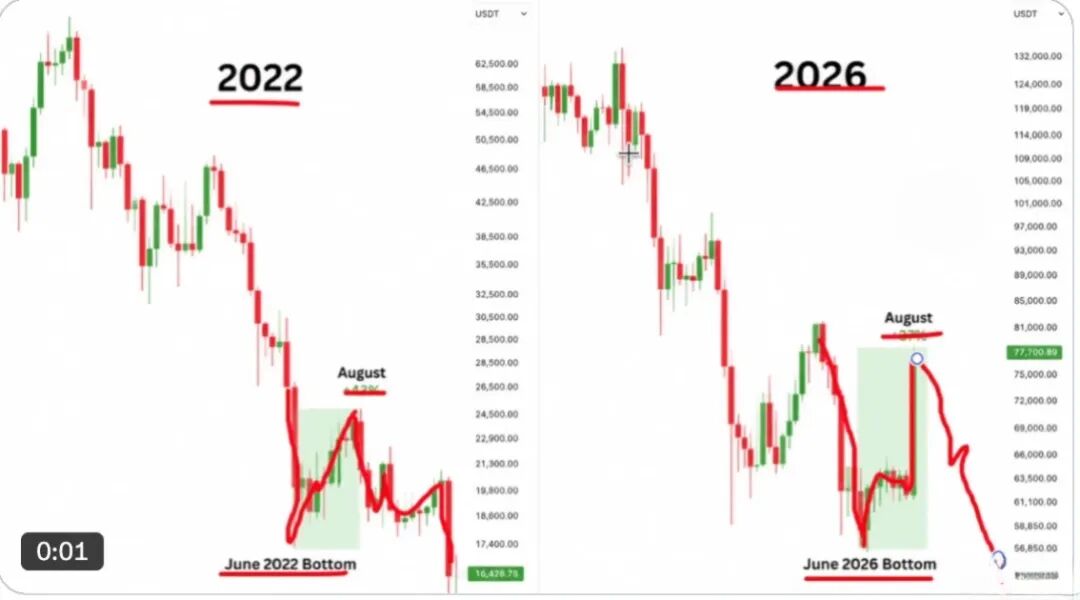
The moment I overlaid the 2022 and 2026 candlestick charts, a chill ran down my spine. It wasn't that the two charts matched perfectly, but rather I suddenly realized: the market is reciting old scripts, and we're the ones applauding from the audience. I suspect many people don't remember 2022, but I truly lived through it. In June, Bitcoin crashed to $17,700, with panic spreading everywhere. It started rebounding in July, accelerated in August, and rose 43% from the low. Back then, the screens were flooded with talk of the bear market ending and a confirmed iron bottom. Then what? August dropped 14%, September fell another 3%, and in November FTX collapsed, hitting a low of $15,500. Those who shouted that the bull market was returning went silent in November. Now it's 2026, and I'm watching almost the same play. The June low was around $59,800, July rose nearly 10%, and August pushed all the way above $77,000, a rebound of about 37% from the bottom. The magnitude is slightly smaller than in 2022, but the rhythm feels like copy-paste. Once is a coincidence, twice is a coincidence, but three times in a row is a script. Many people get one thing wrong. A rebound isn't a reversal; a bear market sometimes gives you a candy first. It's no different from a slap followed by a sweet treat. Let's first look at the drawdowns. In 2022, it fell from $69,000, a drop of about 52.5%. In 2026, it fell from $126,000, a drop of about 52.6%. Both crossed the halfway mark and then precisely landed on the 200-week moving average. This has nothing to do with technical analysis; it's the last few standard moves in market structure before institutionalization. Now look at the rebound's driving force. The 43% rebound in 2022 had no fundamental support; it was purely a technical repair after short leverage got squeezed. In 2026, on the surface, there are positives—the Treasury buying bonds, Trump endorsing the Clarity Act. But on-chain data doesn't look great: ETFs are bleeding, exchange inflows are rising, long-term holders haven't budged, and the selling pressure mainly comes from new institutions that entered between 2024 and 2025. What does that mean? It means old money hasn't moved, and new money is pulling out. This rebound is sellers temporarily stopping, not buyers truly returning. Another thing just hit me. August has never been kind to Bitcoin. The historical median is -7.87%, the worst month of the year. August 2022 fell 14%, and August 2024 wasn't much better. It's not superstition—summer liquidity is inherently poor, traders are on vacation, market makers shrink their books, and any slight disturbance can't hold up. But in 2026, something has genuinely changed. 2022 was a cascade of retail liquidations, with Three Arrows and Celsius collapsing one after another—an implosive bear market. Now the market is institutionalized, with ETFs and sovereign funds smoothing out much of the volatility. The same 52% drawdown in 2022 was a violent crash over months, while 2026 has been much gentler. But gentleness isn't necessarily a good thing. Because institutionalization means slower, duller, and more agonizing. 2022 was a cliff; 2026 might be a slow knife cutting flesh. Recently, Benjamin Cowen shared an observation that's quite interesting: he said the current price is stuck between the bear market resistance band and the 200-week moving average, almost point-for-point matching the 2018 structure, but with only half the volatility. In other words, if history repeats, the decline won't be clean. It will drag on, wear you down, and make you hand over your chips while you hesitate. So what should we watch next? Don't watch Bitcoin; watch the S&P 500. In August 2022, U.S. stocks peaked and then fell 20%, dragging Bitcoin down with them. Cowen's view is that a similar stock market correction hasn't happened yet, and once it does, Bitcoin will struggle to stay immune. The cycle's low might not be confirmed until around November. Also, keep an eye on ETF fund flows. In June, spot Bitcoin ETFs saw their largest net outflow ever, BlackRock's IBIT inflow momentum broke, and Fidelity's FBTC saw continuous redemptions. Institutions rebalance quarterly; once they pull out, they won't rush back just because you've rebounded 20%. There's another signal few people watch—the miners, who can carry the boat or capsize it. In December 2022, miners capitulated en masse, hashrate dropped 7.6%, and the market bottomed. Now? Network hashrate is still at historic highs, marginal miners are near breakeven, but there's no large-scale shutdown yet. Historically, the miner bottom lags the price bottom by one to two months. It hasn't appeared yet, suggesting the bottom may not be complete.
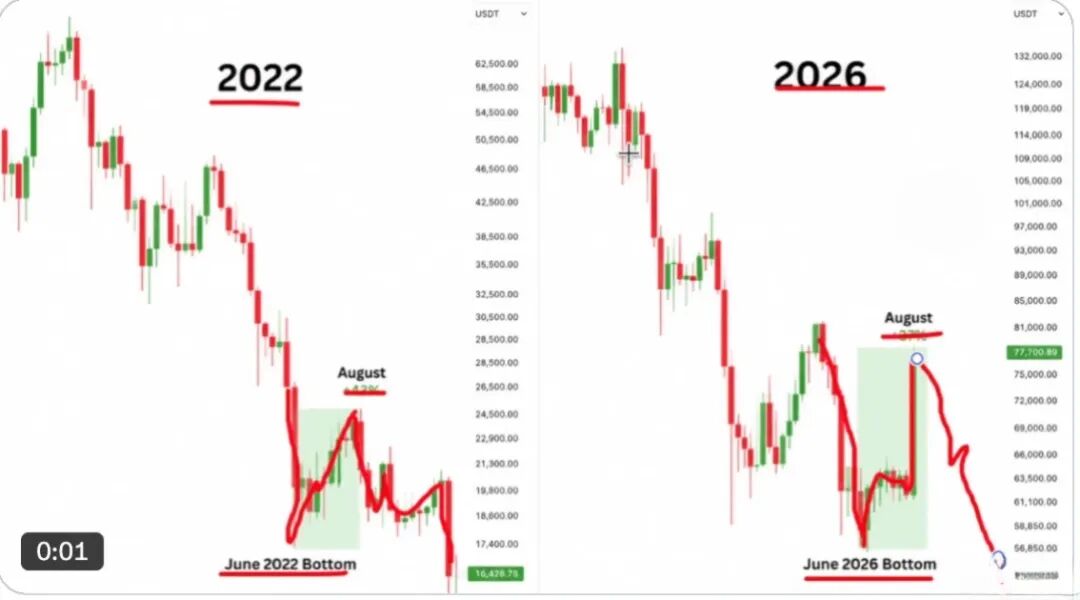
Take another look at this chart—what is it really saying? It's not saying a drop is inevitable. It's saying that when the market tells you a story with nearly identical rhythm, magnitude, and timing windows, you need to flip to the next page. In August 2022, a 43% rebound was followed by new lows. In August 2026, after a 37% rebound, the price is hovering around the 200-day moving average, with the 365-day moving average around 101,000—still far from reclaimed—and on-chain demand indicators don't look great either. Many say this time is different, but it's always the same, just with a fresh batch of retail investors. After all, there are always those who believe in getting rich overnight, just like the lottery industry never goes out of business. If you're also waiting, what are you waiting for? Don't wait for a precise bottom price—wait for three signals to appear simultaneously. First, ETF flows shift from net outflows to sustained net inflows for over two consecutive weeks. Second, miner hashrate shows a clear decline, confirming capitulation on-chain. Third, the U.S. stock market completes at least a 10% correction, fully releasing systemic risk. Until these three conditions align, this rebound looks more like a carefully orchestrated halftime break in a bear market. It gives you hope to let your guard down, and once you truly believe, the door slams shut. History doesn't repeat itself, but it often rhymes. In August 2026, that rhyme sounds a bit familiar. Don't be the one shouting bull market in August and going silent in November. Be the one who stays clear-headed in August and still has cash in November. Below is the version with perspectives from ten experts: