
The crypto market is never short of panic narratives. Recently, claims like "quantum computing will break Bitcoin" and "Satoshi's million BTC will be stolen by quantum hackers" have resurfaced, fueling anxiety among retail investors.
Amid the doomsday rhetoric amplified by the market, many have jumped to a conclusion: once quantum technology matures, Bitcoin's cryptographic defenses will collapse overnight, putting Satoshi Nakamoto's long-dormant 1.08 million BTC at grave risk, and any massive movement of these holdings could trigger a chain reaction across the entire crypto market.
But strip away all the marketing-driven fear tactics and look at the technical principles, key structures, and real-world computational gaps—the conclusion is crystal clear:
At this stage, the threat quantum computing poses to Bitcoin has been wildly exaggerated and prematurely priced in by the market. Satoshi Nakamoto's 1.08 million BTC are currently in an absolutely secure state.
I. What Most People Get Wrong: Satoshi's Holdings Are Not Stored in One Place
The biggest misconception in the market is assuming Satoshi's Bitcoin is held in a "single wallet with a single private key," meaning once quantum computing breaks through, everything could be cracked in one fell swoop.
The reality is the opposite.
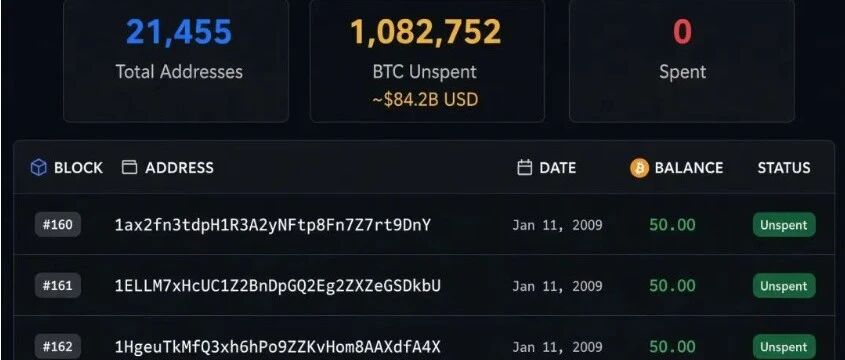
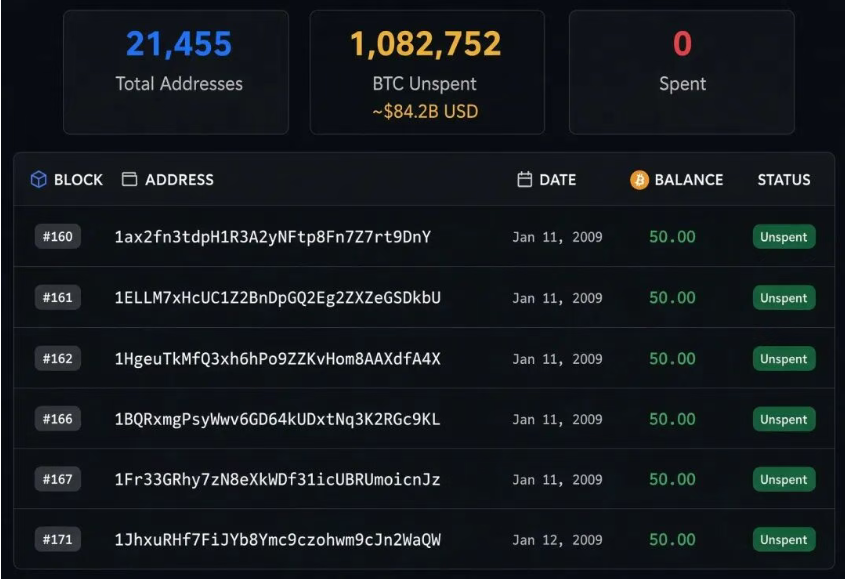
The 1.08 million Bitcoin Satoshi mined in the early days were never consolidated into a single address. Instead, they are highly dispersed across thousands of independent block outputs and private key addresses.
This is a natural, formidable security barrier.
Quantum cracking does not work on a "batch and one-click" basis.
Each private key and each address requires independent computational power and separate cracking operations.
Industry estimates are clear: with current theoretical quantum computing power, cracking a single Bitcoin address would take about 2.5 years.
With thousands of independent addresses, it would require computational power on the scale of tens of thousands of years to crack them all. Even if quantum technology advances in the future, this decentralized key structure would dramatically raise the cost and time required for an attack, making it nearly impossible to steal all holdings at once.
II. Theoretically Crackable ≠ Practically Attackable—A World of Difference
Every quantum panic narrative hinges on a subtle sleight of hand:
Packaging a distant theoretical possibility as an immediate, present-day danger.
From a cryptographic theory standpoint, Shor's algorithm does suggest a path to breaking elliptic curve encryption, and Bitcoin's secp256k1 algorithm will indeed face challenges from quantum computing in the long run.
But theoretical feasibility does not mean engineering reality.
To date, no commercial or experimental quantum computer anywhere in the world can stably, cost-effectively, and efficiently crack Bitcoin's underlying encryption system. Current quantum devices lag by generations in qubit count, error correction, operational stability, and error-rate control compared to what would be required to attack Bitcoin.
In simple terms:
What the technical blueprints say is possible, today's machines simply cannot do.
III. The Only Real Risk: Early P2PK Exposed Public Key Addresses
We are not blindly optimistic, nor do we ignore objective technical risks.
Bitcoin's early blocks heavily used P2PK (Pay-to-Public-Key) output formats, which expose the public key directly on the blockchain.
Unlike newer address formats, these exposed public key addresses carry a potential risk of having their private keys reverse-engineered once advanced quantum computing becomes a reality.
A portion of Satoshi's early holdings happens to sit in these legacy addresses.
This is widely acknowledged within the industry as Bitcoin's only quantum vulnerability.
But it's crucial to keep the timeline straight:
This is a long-term future risk, not an immediate crisis.
It is a technical challenge for years—or even decades—down the road, not a market risk that warrants panic today.
IV. Bitcoin's History of Crises Shows: The Market Loves to Over-Index on Anxiety
Looking back at Bitcoin's decade-plus history, a pattern emerges:
Every market downturn spawns a "Bitcoin goes to zero" doomsday narrative:
51% attack fears, global regulatory crackdowns, energy consumption debates, exchange collapses, stablecoin systemic risks…
Now, quantum computing is just the latest anxiety theme being hyped up.
Every crisis has ultimately confirmed the same truth:
Bitcoin's cryptographic framework has never been a static, unchanging system—it is a dynamic network that can iterate and upgrade.
The core of cryptographic security has never been about being "forever invulnerable," but about having ample time to iterate, upgrade, and hedge before a real risk materializes.
If quantum computing ever approaches a threatening threshold, the Bitcoin ecosystem has plenty of time to upgrade:
Adopting post-quantum signature algorithms, phasing out high-risk legacy addresses, migrating exposed public key assets, and upgrading the underlying encryption protocols.
Technology is always evolving; panic always arrives early.
V. The Real Risk Is Never Technology—It's Emotional Stampede
At this stage, all the quantum-driven bearish news is essentially:
Using a distant future technical risk to exploit current market sentiment.
Many people agonize over whether quantum computing can crack Bitcoin, yet overlook the simplest logic:
1. Satoshi's holdings are highly dispersed, naturally resistant to batch cracking;
2. Current quantum computing power is nowhere near capable of a real-world attack;
3. Bitcoin's protocol can be iteratively upgraded over time to hedge against long-term risks;
4. Every quantum collapse theory in the market is a prematurely priced-in anxiety narrative.
We should not dismiss long-term technical challenges—maintaining rational vigilance is the right approach;
But we must not be swept up by manufactured panic, blindly turning bearish and triggering a market stampede.
Final Thoughts
The quantum threat is a real technical question,
But the quantum collapse is a fabricated market narrative.
Satoshi's dormant million Bitcoin remain rock-solid at this stage.
So-called quantum theft and BTC going to zero are nothing more than recycled themes the market keeps dusting off.
The biggest enemy of investing is never technological evolution,
It's letting distant anxieties destroy your rational judgment in the present.
Stay humble, respect technology, reject panic—
That's the best mindset for navigating every market cycle.