
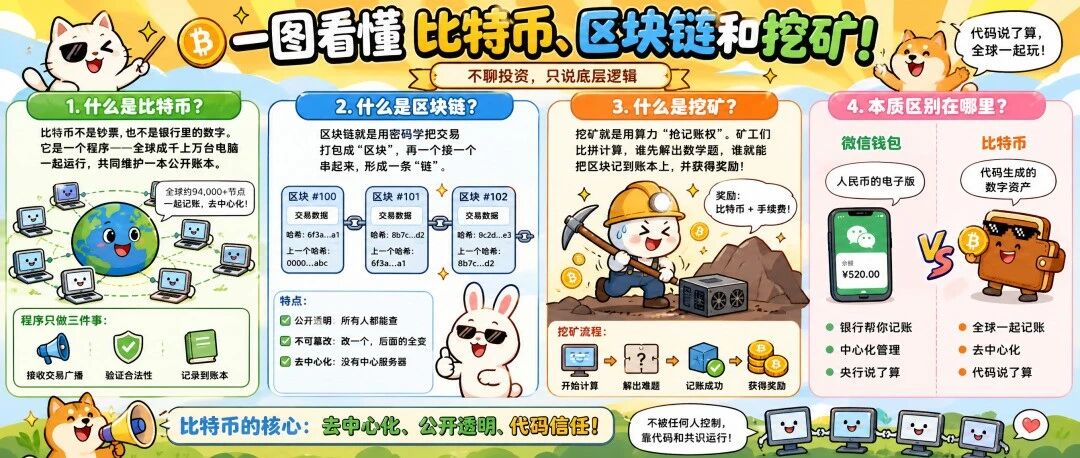
Every day when you open the news, you see Bitcoin going up or down again. But setting aside the price, what exactly is Bitcoin? What's its relationship with blockchain? What is "mining" actually digging for? What's the fundamental difference between it and the balance in your WeChat wallet? This article isn't about investing—it only covers the underlying logic. First, without anyone running it, Bitcoin is nothing. Bitcoin isn't a banknote, nor is it a line of balance on a server. It's a program—thousands of computers worldwide running the same program simultaneously, collectively maintaining a public ledger. The key premise: if no one runs this program, Bitcoin is meaningless. You download the program to your computer, and it does only three things: receive transaction broadcasts → verify legitimacy (signatures, balances, whether it's double-spending) → record to the ledger. Globally, there are over 94,000 nodes running (24,000 of which are publicly visible, with the rest hidden behind firewalls or on the Tor network), distributed across more than a hundred countries, with no central server and no shutdown button.

The essence of Bitcoin: tens of thousands of computers worldwide run the same accounting program simultaneously. If no one runs it, it has no value. The more people involved, the harder it becomes to tamper with the ledger. Second, what is blockchain? Blockchain is the data structure of that ledger. Once each page (block) is filled with transactions, the "fingerprint" (hash value) of that page is written at the beginning of the next page. Want to secretly tear out or alter one page? The fingerprints on all subsequent pages won't match, and you'll be caught immediately.
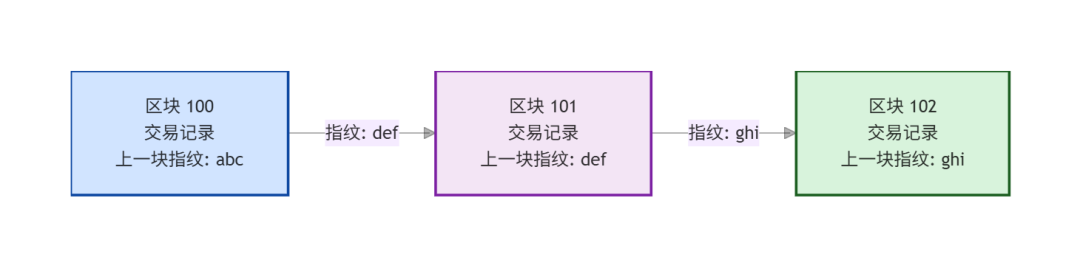
Three core features: - Decentralization: The ledger exists on tens of thousands of computers worldwide, with no single authority in charge. - Immutability: To alter one block, the fingerprints of all subsequent blocks would need to be recalculated. - Transparency: Any transaction can be looked up on a blockchain explorer. Blockchain = a distributed ledger where blocks are chained together using cryptographic hashes. Anyone can view it, but no one can alter it. 3. What is Bitcoin? Bitcoin is the first product built on blockchain technology. In 2008, an individual using the pseudonym "Satoshi Nakamoto" published a whitepaper titled "Bitcoin: A Peer-to-Peer Electronic Cash System," and the program went live in 2009. Analogy: Blockchain is like the "Internet protocol," and Bitcoin is the "email" built on top of it—the underlying layer is technology, while the upper layer is the product. Characteristics: - Total supply: 21 million coins, hardcoded in the code, with no one able to issue more. - Issuance method: Created through mining, with the reward halving every 4 years. - Smallest unit: 1 BTC = 100 million Satoshis. - Transfers: Peer-to-peer, bypassing banks, with verification by nodes across the entire network. - Current block reward: 3.125 BTC (after the 2024 halving). Bitcoin = a decentralized digital currency running on blockchain, with a fixed total supply, open to anyone, and not requiring banks. 4. What is mining actually digging for? What is hash power? Mining isn't about digging for ore; it's about competing for the right to record transactions. It involves solving a mathematical puzzle—whoever solves it first takes the Bitcoin reward for that round. Process: Miners package pending transactions into a candidate block → continuously change a random number (Nonce) → feed it into the SHA-256 hash algorithm → until the resulting hash value is less than the system's target value → success, broadcast the block, and claim the reward.
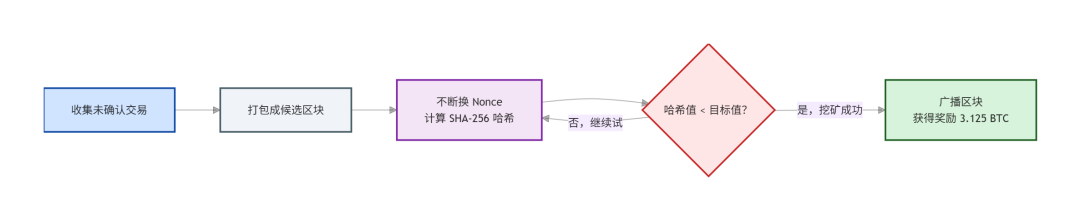
A simple explanation of the concepts: Mining uses computing power to compete for the right to keep records, and whoever wins gets Bitcoin as a reward. Computing power refers to how many hash calculations can be done per second—the higher the computing power, the easier it is to win. Difficulty adjusts automatically every two weeks to ensure a block is produced every 10 minutes on average. Halving occurs every 210,000 blocks (about 4 years), cutting the reward in half until all coins are mined by 2140. The current global total computing power is about 1,000 EH/s (100 billion billion hashes per second), with a difficulty of about 136.6 trillion. Want to tamper with transactions? You'd have to recalculate all blocks after that point and exceed 50% of the network's computing power—the cost is so high that no one can afford it. Mining = using computing power to do hash calculations to compete for record-keeping rights. Computing power is the "problem-solving speed," and Bitcoin turns it into a security barrier. Fifth, centralization vs. decentralization: A diagram makes it clear. The RMB is centralized—issued by the central bank, recorded by banks, with WeChat/Alipay as payment channels. The balance in your WeChat is essentially a "digital entry under your name" in the banking system, which the central bank can regulate. Bitcoin is decentralized—there's no central bank, no central server, and tens of thousands of nodes worldwide keep records together. The total supply of 21 million is hardcoded, and no one can issue more.
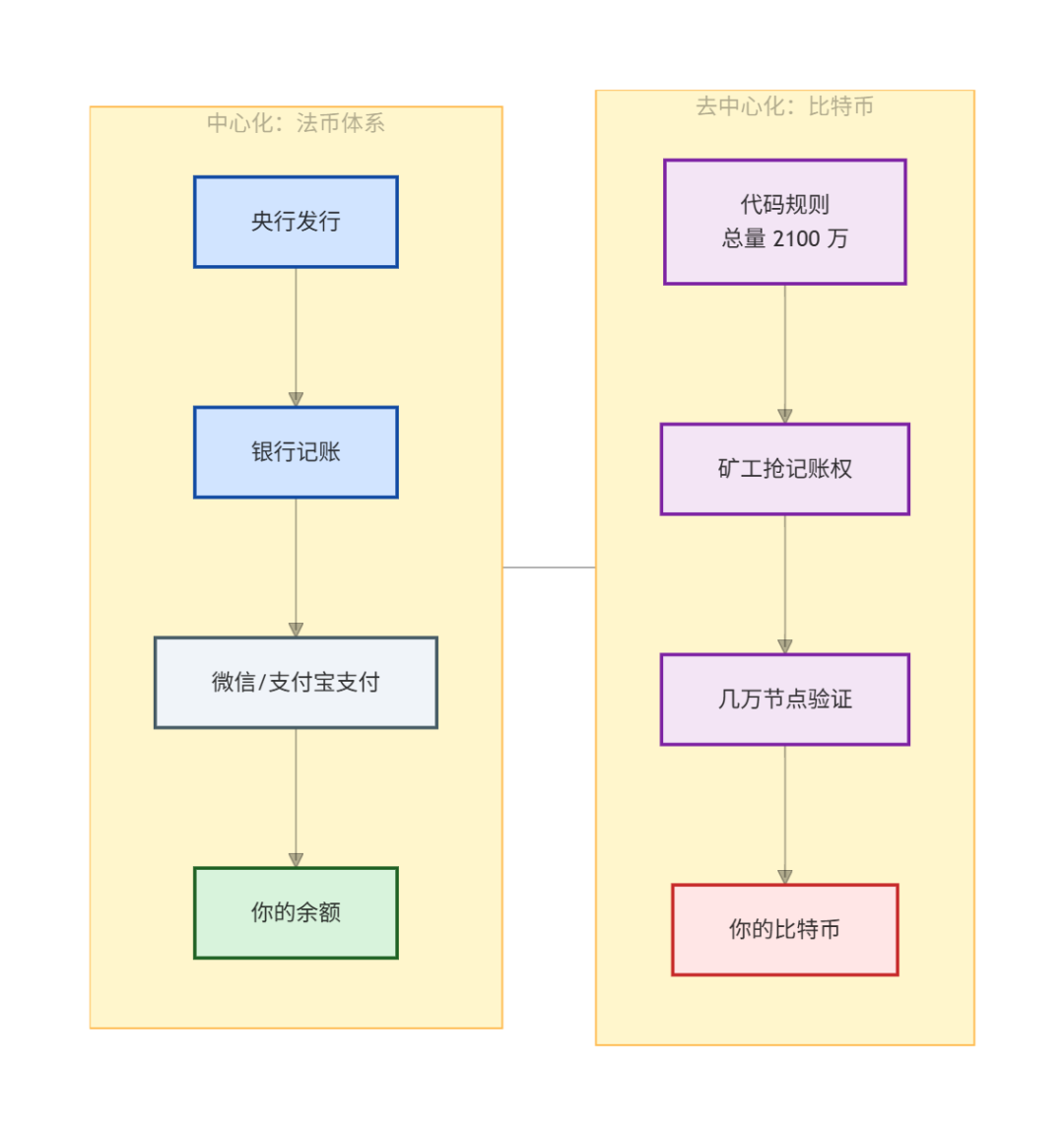
Comparison Dimension | WeChat/Alipay Balance | Bitcoin Nature | Electronic mapping of RMB | Decentralized digital currency Issuer | People's Bank of China | Code algorithm (generated via mining) Bookkeeping | Commercial banks | Tens of thousands of global nodes Total Supply | Controlled by central bank | Fixed at 21 million Can it be over-issued? | No | No Basis of Trust | Central bank, banks, WeChat | Mathematics and code In one sentence: WeChat balance relies on institutional trust, while Bitcoin relies on mathematical trust. One is centralized, the other is decentralized, and their underlying logic is fundamentally different. VI. Summary Blockchain: A distributed ledger technology that uses cryptographic hashing to link transactions into an immutable chain. Bitcoin: The first product on this chain, a fixed-supply, decentralized digital currency. Mining: The process of using computational power to compete for bookkeeping rights, serving as the incentive mechanism to maintain the chain. Core difference: Money in WeChat is the "digital version of RMB," where banks keep records for you and the central bank has the final say; Bitcoin is a "code-generated digital asset," where tens of thousands of computers worldwide keep records together and the code has the final say.