Bitcoin: I Broke $80K; A-Shares: I'll Wait a Bit Longer...
Published: 2026-08-27 09:25
Views: 2,711
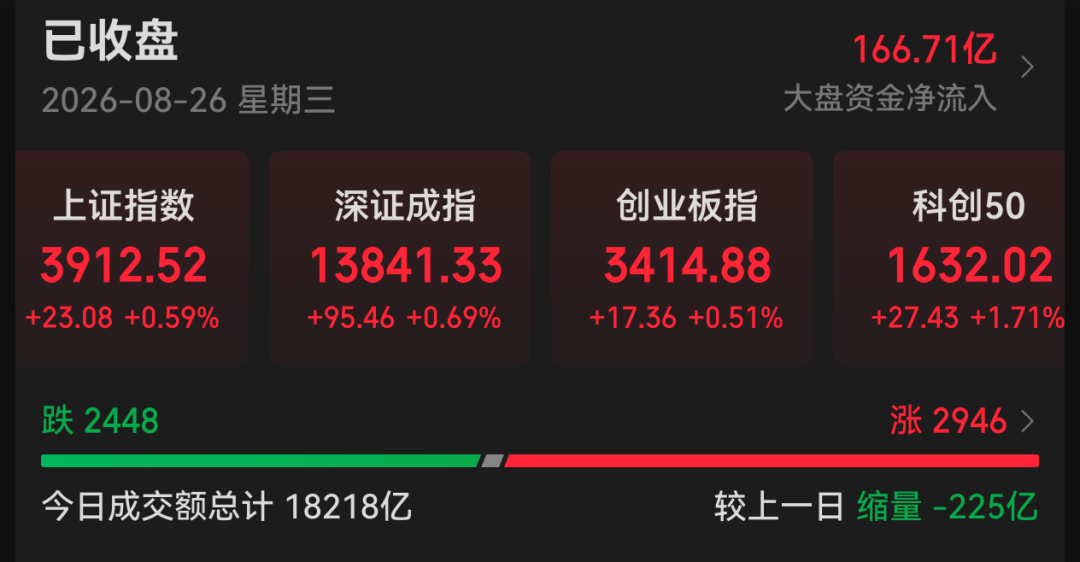
Yesterday's market played out a classic spike-and-pullback scenario—while all three major indices closed in the green, they fell well short of the midday surge. The Shanghai Composite rose 0.59% to close at 3912.52 points, managing to engulf Monday's bearish candle. The Shenzhen Component Index and ChiNext weren't as resilient, gaining 0.69% and 0.51% respectively, neither reclaiming the 5-day moving average. So, is the market stabilizing? I think it's still too early to say.What bothers me most is the trading volume. Around midday, I noticed turnover had expanded by over 80 billion yuan compared to the previous day. But by the close, the full-day figure came in at 1.82 trillion yuan, actually shrinking by more than 20 billion yuan from the prior session. This suggests that during the midday rally, not much fresh capital chased the gains—most traders pulled back in the afternoon, preferring to wait and see.Wait for what? Everyone knows—the market is waiting for two things to land. One is the U.S. July PCE data, the Fed's most-watched inflation gauge. The other is Nvidia's earnings report. These two factors will set the tone for liquidity expectations and AI computing valuations, respectively, and will significantly influence today's tech stock movements in A-shares. Wall Street expects Nvidia's Q2 revenue to be around $92.2 billion. If it beats, great; if it misses, A-share AI-related stocks could feel the tremors. In my view, unless both data points come in surprisingly strong, it's hard to fully reverse the current market sentiment.Sector rotation remained as fast as an electric fan, but yesterday a clear thread finally emerged: the earnings line. With the end of August approaching, interim report disclosures are entering the final stretch, and capital is finally paying attention to fundamentals. The sectors that performed well—gold, securities, and paper—all had interim report catalysts behind them.Gold has been on a tear, with Shenzhen Zhongjin Lingnan hitting five consecutive limit-ups, and Jiangxi Copper, Jinxin Mining, and Baiyin Nonferrous all seeing limit-ups. Speaking of gold, although international gold prices dipped slightly yesterday, London spot gold is still hovering around $4,625 per ounce, with COMEX gold futures at $4,682 per ounce. Domestic gold jewelry prices are even more eye-popping—Chow Tai Fook's pure gold is already at 1,399 yuan per gram. Global gold ETFs saw net inflows of $6.4 billion in a single week, the highest since October last year. However, the latest data shows that the world's largest gold ETF reduced its holdings by 1.14 tons yesterday, indicating some funds are already taking profits at these highs—chasing rallies requires caution. Luoyang Molybdenum rose over 6% yesterday, with net capital inflows of 2.2 billion yuan. Nonferrous metals have been showing some real strength lately, driven by expectations of a weaker dollar and recovering domestic demand, prompting capital to place its bets.The securities sector finally flexed its muscles, with Jinlong Shares and Xiangcai Securities hitting limit-ups. There's another force pushing this sector today—Bitcoin. Bitcoin briefly touched $81,237 yesterday, breaking through the $80,000 mark for the first time since mid-May, though it pulled back during the session and is now around $79,000. When Bitcoin rises, the broader financial sector gets a boost too—Chutian Dragon's four consecutive limit-ups are a case in point. Capital is playing on the resonance of two lines: Bitcoin's sustained climb and brokers' strong H1 earnings. Among the 20 brokers that have disclosed interim reports, Zhongtai Securities posted the largest net profit growth at 146.38%. With A-share turnover hitting a historic 317.5 trillion yuan in H1, brokerages saw full-scale expansion in both brokerage and proprietary trading. Bitcoin sets the stage, brokers take the spotlight—yesterday's financial sector performance was indeed impressive.The paper sector strengthened early in the session, with Qingshan Paper hitting two consecutive limit-ups. But how long can the earnings line sustain? I'd put a question mark on that. At this level, I think it's safer to look for opportunities in relatively low-positioned sectors, or simply adopt a wait-and-see approach. The upside for the broader market is limited, while the downside—theoretically—has more room, though not necessarily a deep plunge. Sector opportunities are mostly structural and unlikely to have lasting momentum.The medical services sector opened higher but closed lower, with Chengda Pharmaceutical falling over 5%. The motor sector fared worse, with Huarui Shares dropping over 15%. This divergence shows that capital is still making selective choices, not spreading the wealth evenly.Let me highlight a few directions worth watching.One is agriculture. Yesterday, the sector showed localized moves, with Hainan Rubber touching the limit-up and Wandong Denong posting four limit-ups in seven days. On the news front, the Ministry of Agriculture and Rural Affairs issued the "15th Five-Year Plan for the Development of the National Agricultural Product Origin Market System," proposing to build 50 agricultural product origin market clusters by 2030. It's a medium-to-long-term initiative, but the market is willing to buy in. The agriculture sector has been steady lately, with supportive news flow, and has the potential to break through previous highs.Another is power. The power sector has quietly strung together five consecutive gains, showing signs of breaking out of its bottom range. "Computing-power synergy" is this year's new theme, and since "computing" is currently under pressure, it makes sense that capital occasionally turns its attention to "power." In the afternoon, Lixin Energy surged sharply, hitting the limit-up within a minute, closing at 13.52 yuan with a buy-side order book exceeding 350,000 lots. Turnover reached 1.586 billion yuan, with a turnover rate of 13.54% and an amplitude of 14.48%. The dragon-tiger list revealed that renowned hot money, Guotai Haitong Beijing Zhichun Road, made a major entry, with a single-seat net purchase of 119 million yuan. Shenzhen-Hong Kong Stock Connect also followed with 25.85 million yuan. But what were institutional dedicated seats doing? They net sold 11.67 million yuan. Hot money piling in while institutions offload—this kind of bullish-bearish divergence is crystal clear on a single stock. This stock has appeared on the dragon-tiger list 12 times since July. Why all the buzz? The company's H1 net profit was 73.02 million yuan, up 715.75% year-on-year. The "Xinjiang Power Transmission" three-channel projects are gradually coming online, along with increased new energy subsidy collections. But the stock price has been on a rollercoaster since July—seven limit-ups in eight days followed by consecutive limit-downs, peaking at 16.88 before reversing. Watching this kind of action is entertainment enough; getting involved requires a sober assessment of your own skills.On the theme front, foldable phones are drawing attention. Apple's first foldable phone is expected to launch on September 9, with a starting price of around 14,999 yuan for the domestic version. Huawei's triple-fold phone is also on the horizon. The global foldable phone market is projected to reach 26.72 million units this year, and Apple's entry alone could drive nearly 30% growth.This year, due to rising memory prices, overall consumer electronics sales have been declining, making it a weak sector. But foldable phones are different—they're a new product that can attract a customer base that's less price-sensitive but more fashion-conscious, creating their own incremental market. Most companies making foldable phone components have small market caps and modest revenues, so a single hit product can drive annual performance. For example, Lens Technology mentioned in a conference call that they supply UTG glass and CPI film for a major client's foldable project—products with high processing difficulty and high value. That said, this sector is currently trading purely on expectations, so volatility will be significant—mind the risks.Another sector that caught the eye yesterday was controlled nuclear fusion. Rongfa Nuclear Power opened with a one-word limit-up, closing at 6.24 yuan per share, with a total market cap of 13 billion yuan. Hawah Tongchuang and Changfu Shares rose over 10%. On the news front, at the 2026 Nuclear Fusion Energy Conference yesterday, nine companies including China Fusion announced collaborative efforts on high-temperature superconducting strong-field tokamak magnets. Fusion is still far from commercial use, but capital is willing to speculate on expectations—nothing to be done about that.Commercial aerospace also had big news—the Long March 6C Yao-1 rocket successfully launched seven satellites in a single mission from the Taiyuan Satellite Launch Center. Here's the key point: it's the first time a Chinese commercial aerospace company has achieved a whole-satellite export to Southeast Asia. The user of Galaxy Aerospace's Lingzhi 09 Thailand CubeSat is Thailand's Geo-Informatics and Space Technology Development Agency. This time, it's not just delivering satellites but also providing a complete solution including ground systems and talent training. From "using satellites" to "understanding satellites," Chinese commercial aerospace companies have taken a landmark step in going global. The Ministry of Industry and Information Technology just stated at a State Council Information Office press conference yesterday that over the next five years, it will accelerate the development of emerging pillar industries such as aerospace, low-altitude economy, and intelligent robots. Policy sets the tone on one side, rockets launch on the other—the timing is quite fitting.Then there's lithium carbonate. Futures prices have rebounded nearly 15% cumulatively since August. On the supply side, domestic lithium salt plants are undergoing concentrated maintenance, and overseas lithium ore arrivals have fallen short of expectations. On the demand side, August lithium battery production is set to exceed 300 GWh, a historic high. Lithium mining stocks have collectively exploded in interim reports—Tianqi Lithium's profit is expected to surge over 32 times, and Ganfeng Lithium has turned from losses to profits. CITIC Construction Investment's assessment is that with the peak demand season arriving in H2, the supply gap will gradually widen, with price highs likely in Q3 or Q4.A few more interesting announcements. Hangzhou Cable's H1 net profit was 393 million yuan, up 938.67% year-on-year. Even more striking, renowned retail investor Zhang Jianping newly entered as the third-largest shareholder with a 3.52% stake. With that level of earnings explosion plus a big-name investor entering, the market has already reacted. Giant Network's H1 net profit was 2.144 billion yuan, up 176% year-on-year. Its hit mobile game continues to generate high revenue, and it plans to distribute 8 yuan per 10 shares as dividends. Game stocks have been cold lately, but this performance is genuinely strong. Changxin Technology announced today that the IPO over-allotment option has been fully exercised, with an additional issuance of 1.003 billion shares. As a leader in semiconductor memory, it has always drawn significant market attention.Overall, yesterday's market performance was middling—not bad, but not strong either. However, since the Shanghai Composite engulfed Monday's bearish candle, I'm leaning slightly more optimistic. Even if the PCE data and Nvidia's earnings disappoint, the Shanghai Composite is likely to maintain a relatively stable consolidation.-END-
Follow us and give a🧡—thanks for your support!
Personal views, for reference or a chuckle—please don't take them too seriously.
None of the content constitutes investment advice—please make your own independent judgments.
Market risk is real—invest with caution.
Data sourced from the internet; will remove upon infringement notice.