Home > 金融资讯 > 商讯 > The Co-Rise Paradox: Why Bitcoin, Gold, and the Dollar Are Rising Together
The Co-Rise Paradox: Why Bitcoin, Gold, and the Dollar Are Rising Together
Published: 2026-08-24 11:13Views: 1,109
When sovereign debt is no longer a safe haven, capital doesn't flee to safety—it flees to everything.
August 24, 2026
In normal times, gold and bitcoin are unlikely partners. The former is a metal that central banks have venerated for millennia; the latter is a cryptographic protocol barely three decades old. Their co-rise has historically signaled distress—a sign that people are fleeing fiat currencies when governments cannot or will not honor their debt obligations. But what happened this week challenges every category in the textbook. Bitcoin is trading around $77,300. Gold is near $4,678. Both are climbing in tandem with the dollar. The traditional narratives—bitcoin as speculative mania, gold as a fear gauge—no longer hold. Beneath the foundations of modern portfolio theory, something structural has shifted.
The data points to a simple but unsettling conclusion: sovereign debt is no longer the anchor it once was. When it ceases to function as an anchor, capital doesn't flee to safety—it flees to everything.
The Illusion of Liquidity
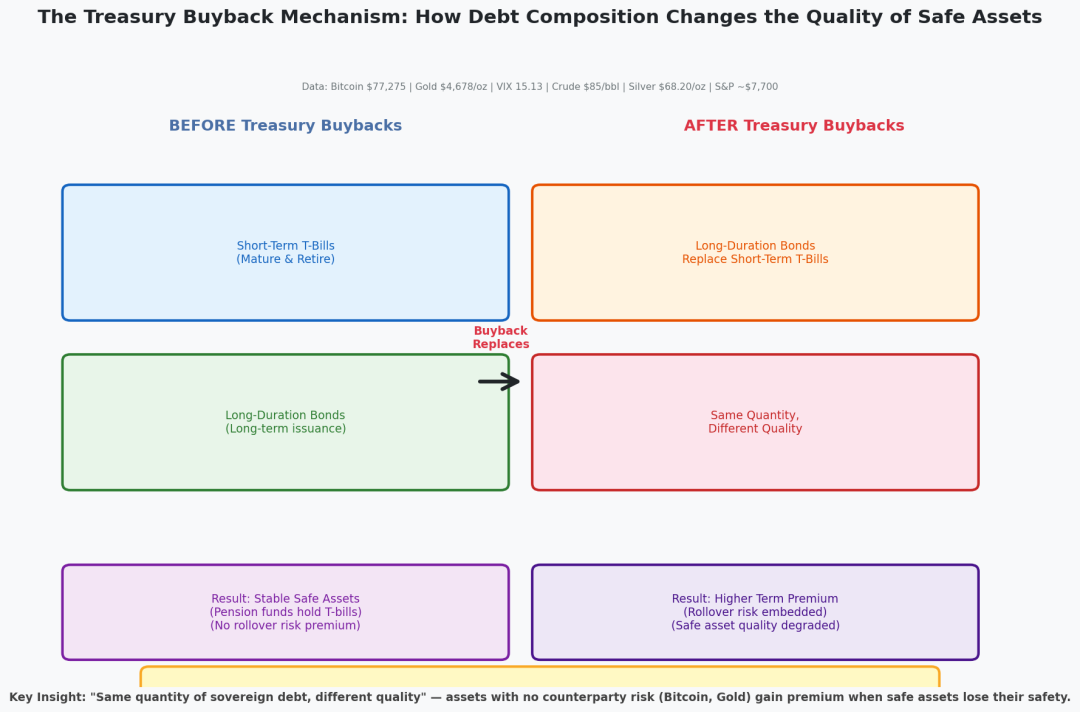
Let's consider what Treasury buybacks are actually doing. By definition, they are not expansionary policy in themselves. The U.S. Treasury issues new debt to redeem maturing old debt—the federal government's balance sheet is merely rearranged. The key isn't quantity; it's quality. Short-term Treasury bills (T-bills) are the closest thing to risk-free money in the financial system. Pension funds, money market funds, and foreign central banks hold trillions of dollars in these assets as their foundational liquidity buffer.
When the Treasury shifts to issuing longer-dated debt—whether through rollovers or deliberate buybacks of short-term bills—it changes the quality of safe assets, even if the quantity remains roughly the same. Long-term sovereign bonds carry duration risk, convexity risk, and increasingly, refinancing risk. The core insight is this: In modern finance, the distinction between "safe" and "unsafe" is determined not by the issuer's creditworthiness, but by an asset's functional properties as a store of value. When that function deteriorates across an entire asset class—sovereign debt held collectively by institutional investors—marginal buyers will turn to alternatives, regardless of their underlying cash flows.
This is not a new discovery. The concepts of "outside money" and "inside money," formalized by Gurley and Shaw (1960), point out that assets that create no corresponding liability on any private balance sheet—gold in their era; bitcoin by analogy today—are hedges against the systemic deterioration of inside money (bank deposits, commercial paper, government debt backed by future fiscal capacity). Their framework was later extended by Minsky (1986) in the Financial Instability Hypothesis, where he argued that the confidence bred during periods of financial stability ultimately leads issuers to expand credit further—until the boundary between inside and outside money becomes blurred. What we are observing is precisely this blurring of boundaries.
Treasury Buyback Mechanism Figure 2. How Treasury buyback operations change the "quality" rather than the "quantity" of safe assets —Short-term T-bills are replaced by long-term bonds, and the homogeneity of safe assets disappears
What is happening now is more subtle than quantitative easing. QE expands the monetary base; Treasury operations rearrange its composition. But the impact on asset pricing converges. When short-term safe assets are absorbed by the Treasury, marginal buyers of the remaining government debt must demand a higher term premium. This premium won't show up in headline statistics until yields move sharply—but it already exists in cross-asset correlations. And that is what makes the puzzle more complex.
The Fracture of Correlations
Standard financial theory predicts three well-defined cycles:
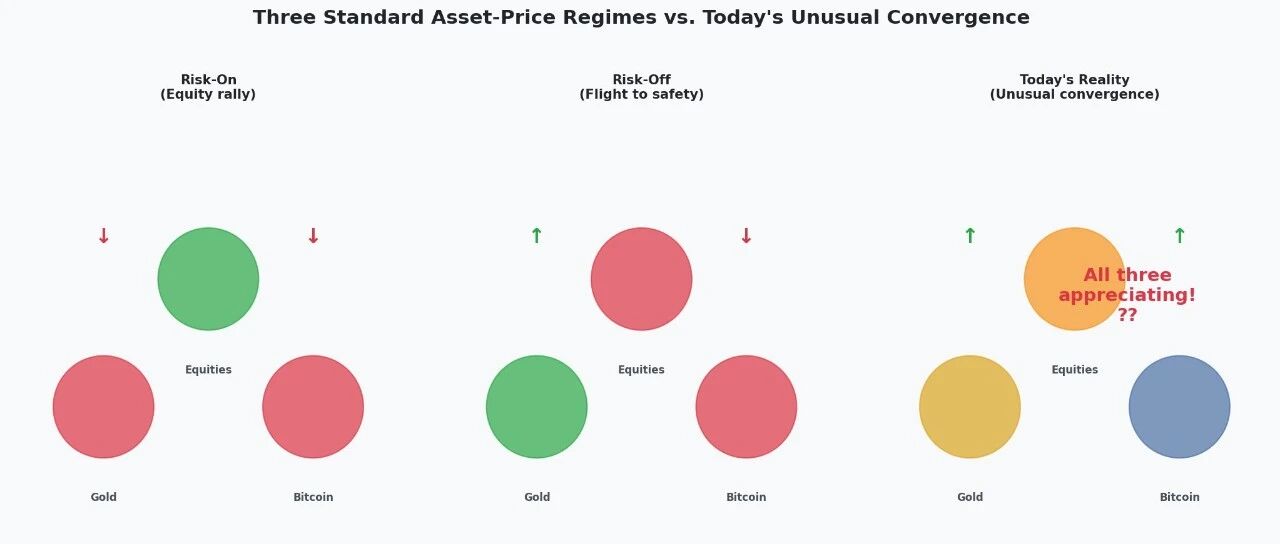
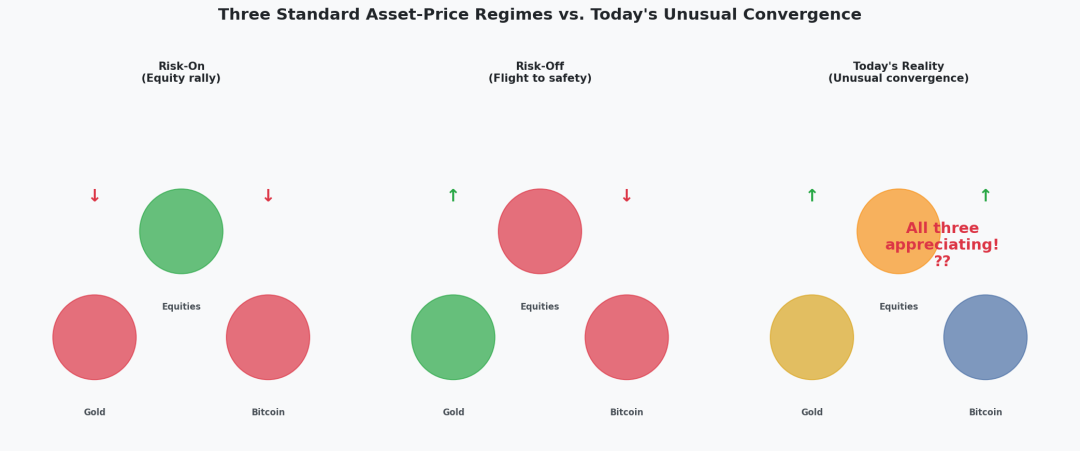
Risk-on periods: Equities rise, gold falls (opportunity cost), and bitcoin moves in tandem with tech stocks. Risk-off periods: All three decline, except gold—which rises on safe-haven inflows. Stagflation periods: Equities stagnate, gold rises, and bitcoin—with neither cash-flow anchoring nor liquidity guarantees—underperforms.
Comparison of Three Paradigms Figure 3. Standard asset price cycles vs. the anomalous convergence seen this week —A "three-asset co-rise" scenario that traditional models cannot capture
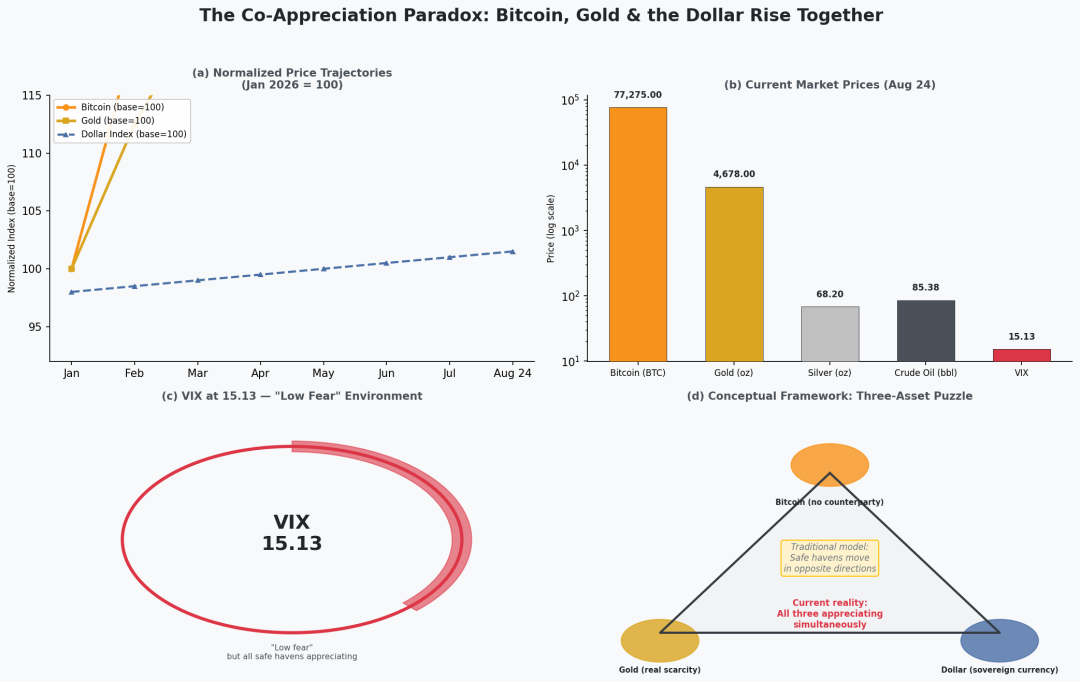
This week, we are in none of these cycles. The VIX is at 15.13, suggesting very low fear. Gold is up roughly 40% year-to-date. Bitcoin is up about 80% from its early-year low. S&P futures are trading around 7,700 but have been range-bound for weeks. Crude oil hovers near $85—a price that should signal inflationary pressure, yet it hasn't transmitted to consumer prices.
The Co-Rise Paradox in Full Figure 1. The co-rise paradox in full: simultaneous upward trend lines for bitcoin, gold, and the dollar —All traditional "safe assets" appreciating at once, defying classical portfolio theory predictions
The fracture of these cycles can be traced directly to the work of Modigliani and Miller (1958)—their theorem established that asset prices are determined by cash flows and risk, under the assumption of ceteris paribus. The key phrase is ceteris paribus: when the composition of sovereign debt changes in ways that undermine the functional safety of government bonds, "all other things" are no longer equal. The result is not price movement driven by growth expectations or inflation forecasts, but a redefinition of the risk-free rate itself.
This redefinition carries consequences that standard models cannot capture. When the foundational assumption of a stable risk-free benchmark becomes invalid, every asset priced against that benchmark must be revalued—not because its fundamentals have changed, but because its frame of reference has shifted. Gold and bitcoin are merely the first assets to trade on this new reference frame; they will not be the last.
The Fiscal Theory Connection
The relevant theoretical framework is the Fiscal Theory of the Price Level, developed by Leeper (1991), Sims (1994), and Woodford (1995). Their core insight: the real value of government debt is determined not solely by monetary policy, but by the present value of future primary surpluses. When markets begin to doubt that expectation—not through an overt crisis, but through gradual recalibration—the price level adjusts simultaneously across all nominal denominations.
In practical terms, this means a portfolio traditionally composed of "safe assets" (40% equities, 40% Treasuries, 20% cash) finds its bond component no longer anchored, because those bonds carry embedded refinancing risk. Investors won't abandon sovereign debt entirely—they lack sufficiently deep alternatives. Instead, they will supplement their allocations with non-sovereign stores of value. The result is a portfolio rebalancing that looks equivalent to a liquidity injection—but with a fundamentally different cause.
This distinction matters enormously for policy. Asset price increases driven by QE imply that central banks should tighten. But a sovereign-trust-driven price increase—where investors add bitcoin and gold not because liquidity is abundant but because standard hedging instruments are losing credibility—implies that conventional tightening is either irrelevant (bitcoin doesn't respond to the federal funds rate) or counterproductive (gold rises on dollar weakness even as real rates climb).
Japan
A parallel development across the Pacific offers corroborating evidence. Japan's borrowing costs have reached their highest level since 1996, marking a fundamental break from decades of yield curve control policy. As the world's largest creditor nation, rising domestic rates mean two things: first, the massive overseas portfolio holdings that have underpinned carry trades for decades are being repriced; second, the yen's traditional role as the global liquidity funding currency is entering a structural transformation.
When the Bank of Japan raises rates—and it is doing so gradually and cautiously—it is not withdrawing liquidity from global markets. It is reconfiguring that liquidity. Japanese institutional investors now face a choice between lower-yielding domestic bonds and higher-risk overseas assets—confronting the same dilemma as investors everywhere: sovereign debt as a whole no longer offers returns commensurate with its political risk.
This aligns with the "impossible trinity" framework that has structured international finance since Mundell (1963) and Fleming (1962): a country cannot simultaneously maintain fixed exchange rates, free capital movement, and an independent monetary policy. What Japanese investors are discovering in 2026 is that when sovereign credit quality—a fourth variable—enters the equation, the impossible trinity becomes an impossible quadrangle. As Japan normalizes its own policy, it is exerting deflationary pressure on global asset prices, because its investors are no longer willing to absorb new sovereign debt at previous yields.
What Happens Next
Three scenarios lie before us.
The first—and most comforting—is that current trends represent a temporary repricing cycle driven by short-term fiscal operations and geopolitical noise. In this scenario, bitcoin and gold will revert to their historical correlation structure once direct uncertainties subside. This is what investors want to believe. The VIX at 15.13 encourages that belief.
The second is more unsettling but more likely. Treasury buybacks represent a structural shift in U.S. financing deficits: issuing long-term debt to manage short-term liquidity, while foreign buyers increasingly demand higher term premiums. The rise in gold and bitcoin becomes the market's pricing of sovereign credit risk that cannot be expressed through bond yields. This process is gradual, self-reinforcing, and difficult for any single institution to reverse.
The third scenario is what keeps portfolio managers up at night: if non-sovereign stores of value begin their own liquidity positive feedback loop—where rising prices attract new entrants, who themselves add demand—then we have moved from repricing to paradigm shift. The historical precedent here is not 2008 or even 1971, but the period after World War I: multiple countries abandoned the gold standard in succession, each creating a chain reaction of competitive devaluation and capital flight.
What distinguishes the current moment from those precedents is digital infrastructure. Bitcoin's settlement layer operates independently of the banking system; gold's physical distribution has never been more efficient. When sovereign debt stress becomes severe enough that traditional hedging mechanisms prove inadequate—or too slow—the alternative infrastructure is already in place. This is not prophecy. It is merely accounting: when an asset class ceases to perform its traditional function, another fills the vacuum.
Conclusion
The appreciation of bitcoin and gold converging with the sovereign currency is not a puzzle to be solved. It is a signal to be read. When every traditional safe haven rises simultaneously, something in the definition of "safe" has changed. The question facing economists, policymakers, and portfolio managers alike is not how this will end—but whether it has already ended, and the market simply hasn't admitted it yet.
Data sourced from Yahoo Finance real-time data (as of August 24, 2026). References:
1. Gurley, J.G. and Shaw, E.S. (1960). "A Notion of Money and Capital." Journal of Political Economy, 68(3), pp. 287–297.
2. Minsky, H.P. (1986). The Financial Instability Hypothesis. Cambridge University Press.
3. Modigliani, F. and Miller, M.H. (1958). "The Cost of Capital, Corporation Finance and the Theory of Investment." American Economic Review, 48(3), pp. 261–297.
4. Leeper, E.M. (1991). "Equilibria under 'active' and 'passive' monetary and fiscal policies." Journal of Monetary Economics, 27(1), pp. 129–147.
5. Sims, C.A. (1994). "A Simple Model for the Fiscal Determination of Prices." Journal of Money, Credit and Banking, 26(2), pp. 389–397.
6. Woodford, M. (1995). "Price-Level Determinacy without Control over a Monetary Aggregate." Carnegie-Rochester Conference Series on Public Policy, 43, pp. 1–34.
7. Mundell, R.A. (1963). "Capital Mobility and Stabilization Policy under Fixed and Floating Exchange Rates." Review of International Economics, 15(2), pp. 230–248 (reprint of 1962 working paper).
8. Fleming, J.M. (1962). "Domestic Financial Policies under Fixed and Under Floating Exchange Rates." IMF Staff Papers, 9(3), pp. 369–379.
9. Friedman, M. (1968). "The Role of Monetary Policy." American Economic Review, 58(1), pp. 1–17.
10. Eichengreen, B. (2011). Exorbitant Privilege: The Rise and Fall of the Dollar and the Future of the International Monetary System. Oxford University Press.
11. Keynes, J.M. (1936). The General Theory of Employment, Interest and Money. London: Macmillan.