

Last week, BTC surged over 23% in a single week, briefly hitting around $79,463—a new high since early summer.
Interestingly, the global situation hasn't exactly calmed down.
Tensions between the U.S. and Iran remain high, and oil prices have climbed again on geopolitical risk. On August 21, Brent crude approached $94, reigniting concerns about energy costs and inflation.
By most conventional logic, this environment should be bearish for Bitcoin.
Yet BTC went from the low $60,000s all the way to nearly $80,000.
So the question becomes:
Is war actually bearish for Bitcoin, or have we been oversimplifying this all along?
Let's Not Rush to Call Bitcoin a "War Hedge"
I've always felt this narrative tends to distort the picture.
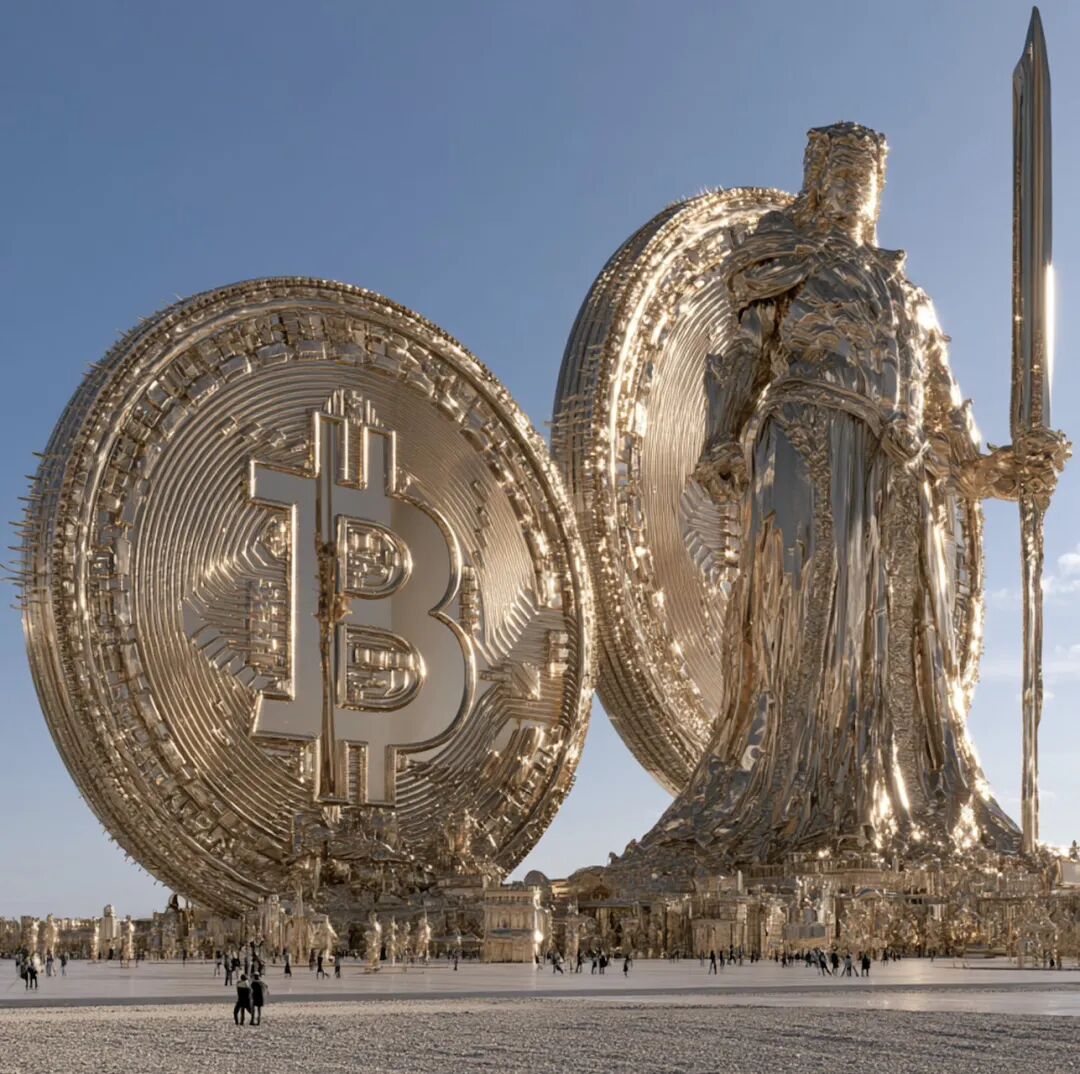
Gold is often treated as a safe haven during wars and financial turmoil—that logic holds up reasonably well.
But Bitcoin is different.
When markets panic, investors sell BTC for cash just like anything else.
In March 2026, when Middle East tensions escalated, Bitcoin saw a sharp drop before bouncing back quickly. In mid-August, as Iran concerns flared again, BTC also dipped to around $64,000.
So war doesn't automatically push Bitcoin higher.
Sometimes the first reaction is actually a drop.
That's easy to understand.
When war threatens energy supply, oil prices rise, inflation expectations tick up, rate expectations shift, and capital tends to flee risk assets first.
BTC is no exception.
So if you only focus on the word "war," you can easily misread the market.
What the market is really trading is everything that comes in war's wake.
So Why Is This Rally So Strong?
I think three things have converged.
One is the U.S. Treasury market.
Another is ETFs.
And the third is regulatory expectations.
After the U.S. Treasury expanded its buyback program for long-dated bonds, the market started asking a new question: Is the U.S. government trying to ease pressure in the long-end bond market?
That's a subtle move.
If Treasury yields head lower, dollar pressure eases, financial conditions improve, and capital starts hunting for returns again.
Gold went up.
Bitcoin went up too.
Last week, gold and BTC rallied strongly together, and the market began revisiting the so-called "dollar purchasing power trade."
You'll notice this isn't the same as "war hedging."
People aren't necessarily buying BTC to bet on escalation—they may be trading the residue left behind when war, fiscal policy, debt, and the dollar system all get tangled together.
That distinction matters.
ETFs Are the Real Heavyweight in This Move
Retail crypto traders tend to overlook this.
Because we stare at candlesticks all day.
Institutions watch fund flows.
From Monday to Thursday last week, U.S. spot Bitcoin ETFs saw cumulative net inflows of about $1.6 billion, with August 20 alone bringing in roughly $606 million—one of the highest single-day inflows since May.
With those numbers on the table, the market naturally starts recalibrating.
When BTC fell to the $60,000s earlier, many assumed institutions had lost interest.
But once the price turned back up, ETF money came flooding back.
And that creates a familiar dynamic:
Price rises → shorts start to crack → shorts cover → BTC keeps climbing → ETF money sees the trend and re-enters → the rally continues.

Last week, over $4 billion in crypto short positions were liquidated, amplifying the short-term surge even further.
So this rally toward $80,000 isn't just about "people frantically buying BTC."
A huge number of people are being forced to buy back in.
Those two sources of buying pressure are completely different.
The Vibe on Binance Square and X Has Shifted Too
This is actually more telling than many indicators.
Not long ago, scrolling through Binance Square, I saw a flood of posts like "We'll see $60,000 or lower" and "Waiting for $50,000 to buy the dip."
Some said they were done trading.
Others said they didn't want to look at charts this year.
A few had even deleted their trading apps.
Then BTC rallied, and the comment sections switched languages overnight.
"Should've gone all-in at $60,000."
"Missed it again."
"Do I dare chase at $70,000?"
And people are already mapping out $80,000, $90,000, $100,000.
X is much the same.
Some post profit screenshots, some share their "finally broke even" moments, and others lament: "I held for so long, and the moment it comes back, I want to sell."
That's the most fascinating part of markets.
At $60,000, everyone feared a drop.
At $80,000, everyone fears missing the boat.
Same price, same people—only the position on the chart has changed.
So often, the market isn't short on opportunities.
It's that when opportunities appear, most people lack the courage to act.
War Has Actually Exposed a Fascinating Side of BTC
It's no longer just a "crypto-native asset."
When the Treasury market moves, BTC moves.
When the dollar moves, BTC moves.
When ETF money flows in, BTC moves.
When U.S. regulatory policy shifts, BTC moves.
When geopolitics flare up, BTC moves.
Even a few words from the U.S. president can move the market.
It's almost absurd.
Something that many dismissed as an internet experiment just over a decade ago is now sitting on the global chessboard of capital.
Some treat it like gold.
Some treat it like a tech stock.
Some treat it as a high-risk asset.
And some see it as an alternative outside the dollar system.
Everyone is pricing BTC in their own way.
That also explains why it's so hard to draw a simple causal line between war and Bitcoin.
War isn't a switch.
It's more like a stick poking the global financial system—and then the dollar, oil, bonds, rates, stocks, and crypto all move together.
Which direction BTC ultimately goes depends on where capital ends up flowing.
So What Matters After $80,000?
I'd advise against obsessing over when $100,000 arrives.
Because BTC has already moved from the low $60,000s to nearly $80,000—that's fast enough.
A weekly gain of around 23% like last week is itself a sign that the market is overheated in the short term.
At this point, the biggest risk isn't the rally itself.
It's when everyone starts believing "it only goes up."
That phrase is basically a danger signal in crypto.

Going forward, I'd rather watch three things.
First, can ETF inflows continue?
If ETFs keep absorbing BTC, it means outside capital is willing to take supply.
If ETF money suddenly starts flowing out in size, we need to question whether this rally is mostly short-covering.
Second, can BTC hold around $80,000?
Touching $80,000 and holding $80,000 are two different things.
A wick into the $80,000 zone doesn't confirm the market has entered a new phase.
What's worth watching is whether buyers step in after a pullback.
Third, the inflationary pressure from war.
If oil keeps climbing, central banks' room to cut rates will shrink. European markets are already revisiting how energy prices affect inflation and rates.
If that spirals out of control, it's not good news for risk assets.
So don't ignore all the bearish factors just because BTC is up.
I Prefer to See This Rally as a "Stress Test"
Over the past few months, BTC has weathered panic, liquidity tightening, weak ETF flows, and geopolitical shocks.
And after falling to the low $60,000s, it clawed its way back above $70,000 and even toward $80,000 within days.
At the very least, that tells us one thing:
The market's ability to absorb BTC is stronger than many assume.
But that doesn't mean war is now bullish for Bitcoin, nor does it guarantee a continued sprint past $80,000.
Markets aren't that simple.
War can push oil higher, but it can also drive capital out of risk assets. Fiscal expansion can bring liquidity, but it can also bring inflation. A weaker dollar can lift BTC, but the dollar can strengthen again for other reasons.
All of these eventually funnel down to one thing:
Capital.
Where capital flows, prices follow.
So if this rally ultimately carries BTC from the low $60,000s to even higher levels, the most important takeaway isn't "war pushed Bitcoin up."
It's that we've witnessed once again:
When global markets start rethinking debt, the dollar, liquidity, and asset purchasing power, Bitcoin is already seated at the table.
As for whether it can keep climbing from $80,000.
Don't rush to call a bull market, and don't rush to call a top.
First, watch who's buying next.