

Author: Matt Cole, CEO @Strive
Translation: Qin Jin
Editor's Note: The views expressed here are solely those of the author and should not be construed as investment advice or as a recommendation to engage in any investment transaction.
Below is Article 1, enjoy:
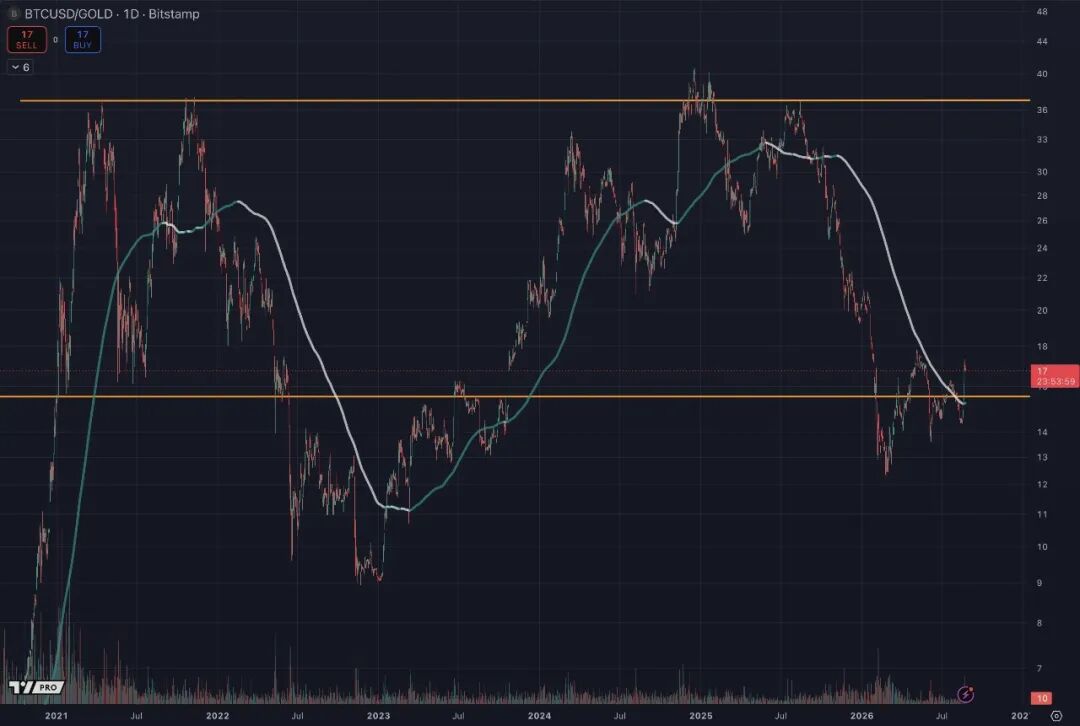
Bitcoin priced in gold is further confirming my view: the next Bitcoin cycle will be the strongest we have ever seen.
The dollar logic I outline below, combined with the growing chase for scarcity in an AI-driven world of abundance, forms a powerful structural tailwind for scarce assets. The Bitcoin/gold ratio (BTC/gold) is flashing another key signal: in this expanding scarcity trade, Bitcoin may be regaining its relative leadership and reclaiming its position as the "fastest horse."
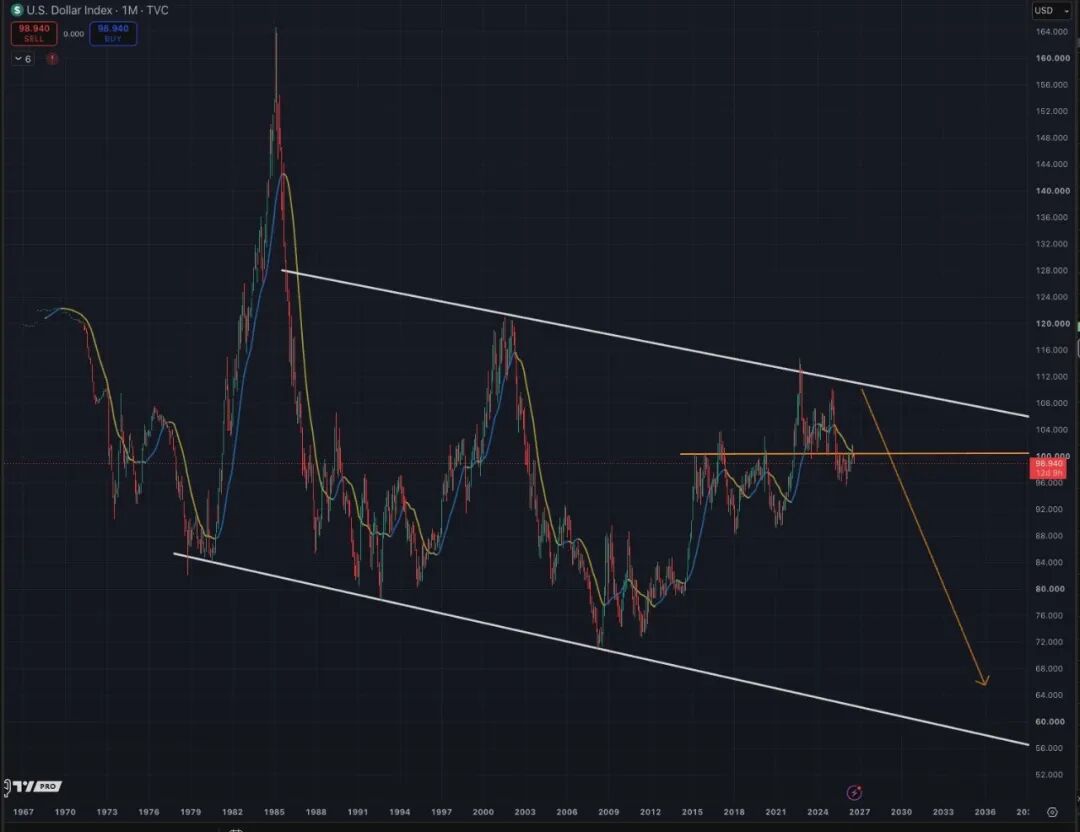
This logic begins with two structural forces driving more capital toward scarce assets.The first is the dollar.As I wrote earlier this week in the piece below(Editor's Note: see Article 2), I believe the dollar is likely beginning a new secular leg lower, and the ultra-long-term pattern of the U.S. Dollar Index (DXY) confirms this view. Bitcoin has never experienced such a macro environment in its history, which will provide it with an unprecedented tailwind.
The second is the intensifying pursuit of scarcity in an AI-driven, increasingly abundant world.As artificial intelligence becomes cheaper and more ubiquitous, many things that investors once valued for their scarcity—including knowledge, software capabilities, and the traditional moats of established businesses—are becoming increasingly easy to replicate. Capital will be increasingly willing to pay a premium for forms of absolute scarcity that cannot be mass-produced out of thin air, and scarce assets such as Bitcoin, gold, and silver will benefit enormously from this shift. This is another structural macro tailwind that Bitcoin has never had before.
Together, these two forces will drive more capital than ever before into scarce monetary assets. Gold will benefit, and so will Bitcoin.My long-held view is that in the trade against global currency debasement and the chase for scarcity, Bitcoin will be the "fastest horse," and the Bitcoin/gold ratio is the window through which to observe when this leadership manifests in the market. If Bitcoin can outperform gold while capital accelerates into both assets, the explosive potential of this opportunity will far exceed what a single tailwind could deliver. Over the past two years, BTC/gold has also been an extremely powerful leading indicator for Bitcoin's own trajectory.
Bitcoin priced in gold (BTC/gold) peaked as early as December 2024, while Bitcoin against the dollar did not peak until October 2025, nearly a year later. Although Bitcoin continued to set new highs in dollar terms, it had already shown weakness against gold. For an emerging monetary asset, this is crucial—bull markets require incremental capital, ample liquidity, and the reflexivity effect where "the more it is sought after, the more attractive it becomes" to push prices higher. In hindsight, BTC/USD showed superficial strength at the time, while BTC/gold revealed that the foundation of the underlying bull market was becoming increasingly fragile. Eventually, that fragility inevitably spread to the dollar price.
This helps explain why, during the current bear market, market sentiment has been extremely negative even though the dollar-denominated drawdown has been relatively mild by Bitcoin's historical standards. Because the previous bull market never demonstrated the leadership dominance that investors had expected from the outset. Bitcoin barely managed to set new dollar highs while underperforming gold, and then slid into a bear market from that fragile underlying pattern. When a bull market never delivers on the "fastest horse" expectation, even a modest nominal drawdown that follows feels especially painful.
The bottoming process sent a similarly telling signal in reverse. Bitcoin bottomed against gold in February 2026, while Bitcoin against the dollar did not bottom until roughly five months later in July. This is the core reason I repeatedly emphasized the BTC/gold trend during the first half of this year at the True North event during Strategy World, the Prague Bitcoin Conference, and on The Hurdle Rate podcast. The ratio warned of deterioration well before BTC/USD peaked, and it showed signs of bottoming while Bitcoin was still weak in dollar terms. This was one of the key signals I tracked closely to demonstrate that the broader Bitcoin bear market might be ending much sooner than the dollar chart suggested.
Compared with previous Bitcoin bear markets, there is another important difference this time: the broader capital markets have remained open, and the wider stock market has stayed strong, continuously hitting new all-time highs. Historically, Bitcoin bear markets have often coincided with a severe deterioration in the overall risk-asset environment. This time, the weakness has been concentrated mainly within Bitcoin and its related ecosystem, making the early recovery in the BTC/gold signal all the more intriguing.
What is particularly striking this week is that Bitcoin has achieved a dual breakout against both the dollar and gold, and the breakout has been exceptionally powerful. Even if a significant pullback occurs from current levels, I would not be surprised, but it is also entirely possible that it continues straight up. If a correction does happen, I expect any meaningful dip to attract aggressive bargain-hunting buying, and I firmly believe that the Bitcoin bear market is definitively over. If BTC/gold has once again served as a leading indicator, then witnessing these two ratios now moving higher together fills me with even greater confidence in the larger opportunity that may unfold over the next 12 to 18 months and beyond.
A weakening dollar accompanied by sustained currency debasement, combined with the pursuit of lasting scarcity in the AI era, will create an extremely favorable macro backdrop for scarce assets. The relative performance within this trade will determine where incremental capital and liquidity ultimately flow. When Bitcoin becomes the "fastest horse," it will capture a disproportionate share of capital. Stronger relative performance deepens liquidity, deeper liquidity creates more optionality, and that optionality in turn attracts even more capital. If these structural forces expand the overall scarcity trade while Bitcoin simultaneously reasserts its leadership over gold, then Bitcoin will capture an increasingly large share of the growing global capital pool.
This landscape makes me more bullish on Bitcoin today than at any point in the past. Gold has thousands of years of monetary history behind it, while Bitcoin combines absolute scarcity with global liquidity, portability, and a network that can settle value anywhere in the world, around the clock. The long-term decline of the dollar, the AI-driven chase for scarcity, and Bitcoin's renewed relative leadership—these three forces converging will create a golden opportunity for Bitcoin unlike anything it has seen since its inception.
This analytical framework has profoundly shaped how we build Strive. When assessing risk, we consider far more than just surviving a severe deep drawdown. For an emerging asset with such enormous upside potential, we believe the greater risk lies in being too conservative: either by not being bullish enough, or by being bullish but structuring the company's equity in a way that limits common shareholders from fully enjoying the benefits when the upside scenario plays out.
This is precisely why we firmly oppose "trying to outperform Bitcoin's own returns through acquisitions, heavy investments, or by primarily focusing on building cash-generating businesses." If your underlying investment thesis is that Bitcoin will appreciate significantly, then waiting for future cash flows to buy Bitcoin is tantamount to buying fewer assets at higher prices. A cash-flow business may appear prudent on the surface, but if converting that economic value into Bitcoin today would generate higher expected total returns under the most probable scenarios, then a conservative cash-flow strategy will ultimately underperform significantly from a total-return perspective.
Across the full probability distribution, we believe that maximizing the expected total return of $ASST(Editor's Note: the stock ticker of Strive, Inc., the author's company, listed on the Nasdaq in the U.S.) hinges on pushing the amplification of Bitcoin exposure to the maximum within reasonable and controllable bounds—while adhering to strict capital discipline: zero debt, zero margin requirements, and no forced liquidation mechanisms. This structure may appear simple on the surface, but that is intentional; the real skill lies in carefully balancing both tails of the probability distribution: how deep a drawdown can the structure withstand, and whether you are sacrificing too much upside in the mechanism when Bitcoin fully breaks out?
If this macro logic plays out, the power of this model will be extraordinary. The scarcity trade itself is expanding, Bitcoin is capturing a larger share of it, and $ASST is designed to amplify Bitcoin exposure on top of that. This amounts to three mutually reinforcing layers of upward momentum working in concert: a larger potential opportunity pool, Bitcoin capturing a higher share, and our common stock leveraging Bitcoin's returns.
This is why we are so committed to building the perfect capital structure. Our upside potential is by no means dependent solely on Bitcoin rising in a straight line; rather, it is about letting $ASST multiply that outcome within a compliant and robust framework while Bitcoin leads the scarce-asset trade.
This bear market has allowed us to test this design in practice. In particular, when Bitcoin was near the cycle bottom, we continued to add positions decisively, including buying almost every week in the months leading up to this breakout. We built this structure precisely so that it would remain solid through harsh market conditions while retaining high amplification and the ability to deploy capital when opportunities are most attractive; now, we have proven it with real, tangible results.
In the BTC/gold dimension, there is another detail from the bear market that is highly noteworthy: Bitcoin bottomed against gold in February, about five months before it bottomed against the dollar in July; and ASST also bottomed in February, well before the broader Bitcoin-equity sector bottomed around July. I do not believe this timing coincidence is purely accidental.
In both cases, the market turned first in the areas most sensitive to improvements in liquidity and risk appetite. BTC/gold was already signaling strength, indicating that the "fastest horse" in the anti-debasement trade was regaining momentum; and ASST, as the high-beta expression of that logic, strengthened first. As market confidence in Bitcoin recovered and capital extended outward along the risk curve, our capital structure, amplification effect, and ample liquidity naturally made $ASST the preferred destination for incremental capital. The high degree of synchronization in these two turning points is powerful evidence of this parallel logic.
It is one thing to calculate a structure on paper; it is quite another to witness the balance sheet and common stock deliver outstanding results through a real drawdown. I believe that our ability to build and maintain high Bitcoin amplification over the long term, combined with the capital structure and liquidity support needed to navigate market cycles, will ultimately grant us a premium valuation relative to Bitcoin holdings. This bear market has been the proving ground for refining this performance engine; now, with ample liquidity in both our common and preferred stock, a debt-free and unlevered balance sheet, the company is fully prepared for the new Bitcoin cycle ahead.
A weakening dollar and currency debasement, the AI-driven wave of abundance, and the $BTC/gold ratio are all sending different but complementary signals. The first broadens the overall monetary opportunity, the second raises the premium on irreplaceable absolute scarcity, and $BTC/gold clearly demonstrates how much share Bitcoin can capture in competition with other scarce assets vying for the same capital. Any one of these factors alone would be highly constructive; if they evolve together along their established logic, Bitcoin will enjoy the most favorable macro and relative-performance landscape in its history, creating unprecedented upside over the coming years.
In one sentence: You are not just under-bullish—you are off by an entire order of magnitude (your bullishness needs to be squared)!
Below is Article 2, enjoy:
For over a decade, I have argued that the U.S. Dollar Index (DXY) is in a long-term structural downtrend, and that this trend will continue. I also believe we are currently approaching a more significant downward phase, which has profound implications for Bitcoin. If this assessment holds, the macro environment Bitcoin will face over the next five to seven years will be significantly more favorable than anything it has experienced in its history.
This chart dates back to the late 1960s. What makes it so compelling to me is not just the clear technical pattern of lower highs and lower lows formed over the past roughly 45 years, but also the fact that this technical pattern is supported by solid fundamentals.
I have spent most of my career studying these fundamentals, including during my time managing U.S. Treasury portfolios at the California Public Employees' Retirement System (CalPERS). That was before I became a Bitcoin supporter, but that experience directly led to my later shift in perspective. The trajectory of federal debt and deficits, the duration risk embedded in long-term Treasuries, and the incentive structure of policymaking under the weight of sovereign debt all point to the same conclusion: the dollar is in an irreversible structural decline. More than a decade later, this core logic remains as solid as ever.
Today, the scale of debt is expanding exponentially, fiscal deficits remain persistently high, and policymakers still face the same fundamental trade-off: they can either endure the pain of substantially higher real interest rates and tighter financial conditions, or they can seek to delay the pain by keeping real rates low, maintaining market liquidity, stimulating nominal growth, and tacitly accepting a degree of currency debasement. There is no cost-free choice; the only difference lies in where the cost is ultimately borne.
This is enormously significant for Bitcoin. Every epic bull market in Bitcoin's history has coincided with a phase of dollar weakness: during the 2017 bull market, DXY fell from around 103 to 88; in the 2020-2021 cycle, DXY slid from around 103 to 89; and in the 2025 rally that drove Bitcoin to new all-time highs before entering the current 2026 bear market, DXY also declined from around 108.
These declines are certainly significant, but they remain mild compared with the several super-cyclical dollar downtrends of the past 45 years. The breakdown that began in the mid-1980s lasted for years, and the depreciation wave that ran from the early 2000s through the global financial crisis also spanned years. My base-case forecast is that the dollar is about to embark on a new deep decline lasting three to seven years, with DXY potentially even testing the historical low below 70 from 2008.
If this scenario unfolds, Bitcoin will enter a macro era it has never experienced before. Its past bull markets have benefited from episodic dollar weakness, but it has never truly experienced the super-tailwind of a genuine long-cycle structural collapse of the dollar as foreshadowed by this chart.
Sharing this chart today is especially meaningful—because the U.S. Treasury just announced that it will at least double the size of its liquidity-support repurchase operations for 10- to 30-year Treasuries. This comes at a time when long-end Treasury yields are under enormous pressure, and the dollar index has also tumbled sharply today in response.
For me, this is merely another vivid data point validating the logic I have been articulating for over a decade. Fiscal constraints are tightening further, the debt burden is intensifying, and the policy incentives are becoming increasingly transparent. None of this has weakened the original logic; on the contrary, it has only strengthened my conviction in this overarching trend.
This is precisely why I believe the vast majority of people are still not bullish enough on Bitcoin when looking ahead five to seven years. Most forecasts are based solely on Bitcoin's historical performance, but Bitcoin has never before enjoyed the era-defining tailwind of a truly long-term structural collapse of the dollar. We often say "past performance is no guarantee of future results" out of concern that the future may be worse than the past; but in the current landscape, I believe this asymmetric risk actually points to upside far exceeding anything seen before.
This also explains why I am so committed to amplifying Bitcoin exposure, and why I joked yesterday that my amplified exposure is still far from enough. If this 45-year dollar macro trend ultimately breaks down completely, the tidal wave Bitcoin will face will be far more powerful than any cycle it has experienced before.
In one sentence: You are still far from bullish enough!
Dear readers,please star "Carbon Chain Value", otherwise you may miss our latest updates. Every piece of content we carefully craft and curate aims to bring readers rational thinking and inspiration.