
Let's start with this: last week, crypto went wild again. And this time, the biggest gains weren't in Bitcoin.
Let's lay out last week's numbers so you can see the full picture
We've been tracking the web3 space closely, so let's break down the data from this rally—
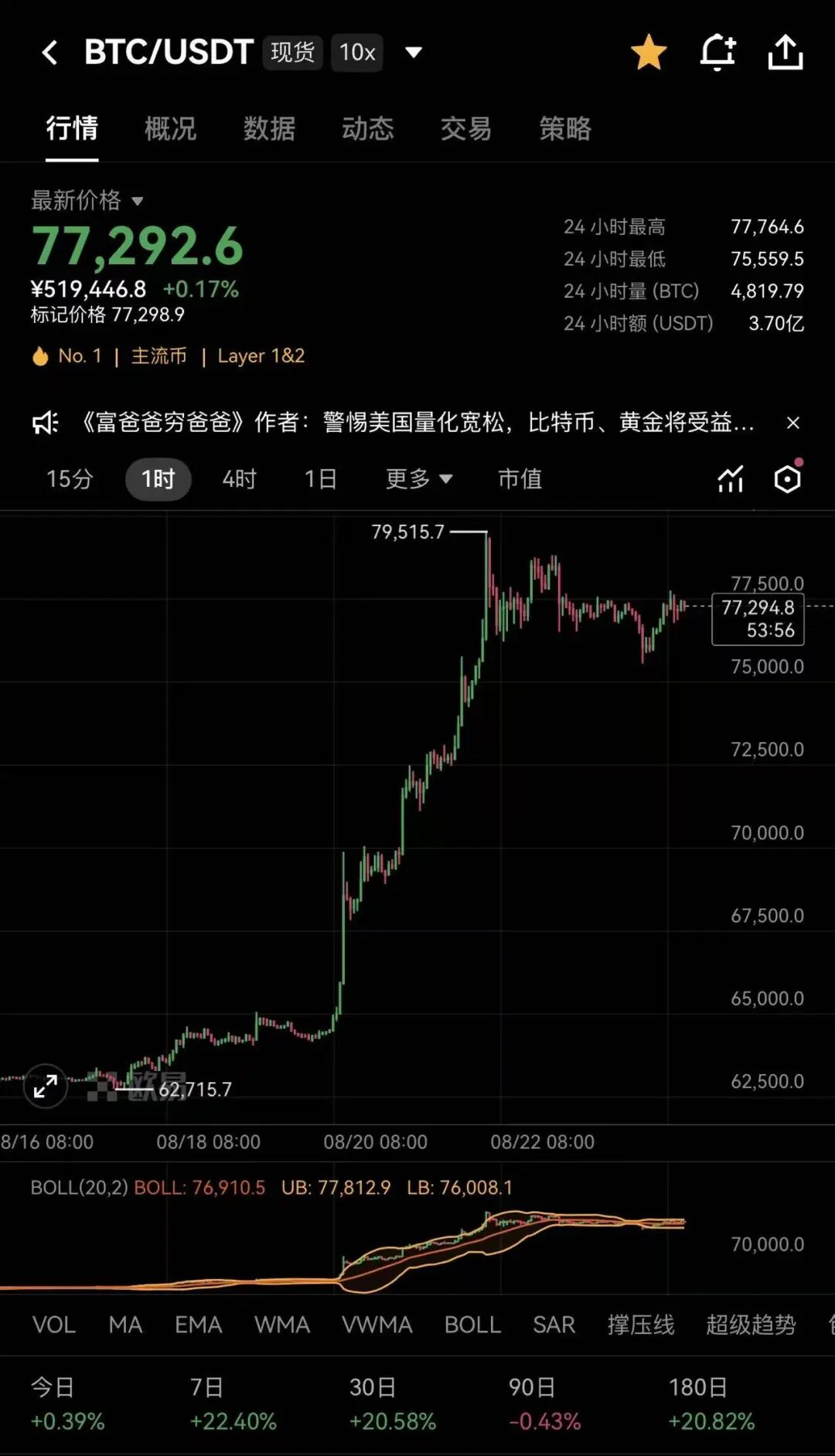
Bitcoin surged past $69,000 and briefly touched $70,000—the first time it's reclaimed that level since early June. On the surface, that's impressive.
But Ethereum went even harder.
It broke out of a month-long narrow range stuck between $1,850 and $1,950, spiking 18.2% in a single day—from $1,910 all the way to $2,258—and posting nearly 19% gains for the week. That put it well ahead of Bitcoin.
And it didn't stop there. Short sellers were squeezed into $1.4 billion in liquidations, and the total crypto market cap added $110 billion out of thin air in just 20 minutes. Standard Chartered has already raised its year-end Bitcoin target to $100,000.
On the surface, it looks like a broad rally. But if all you see is "Bitcoin went up again," you're missing the sharpest story of the week.
The real catalyst wasn't Bitcoin or Ethereum. It was a name Trump personally dropped at the White House—an exchange built by a Chinese founder.
What sparked the surge: one sentence from a White House meeting
This rally wasn't triggered by news about any particular coin—it came from a White House meeting.
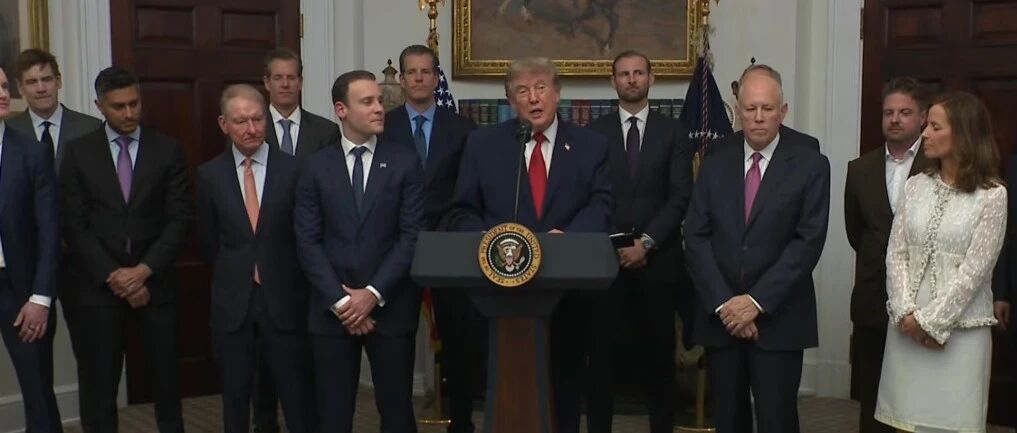
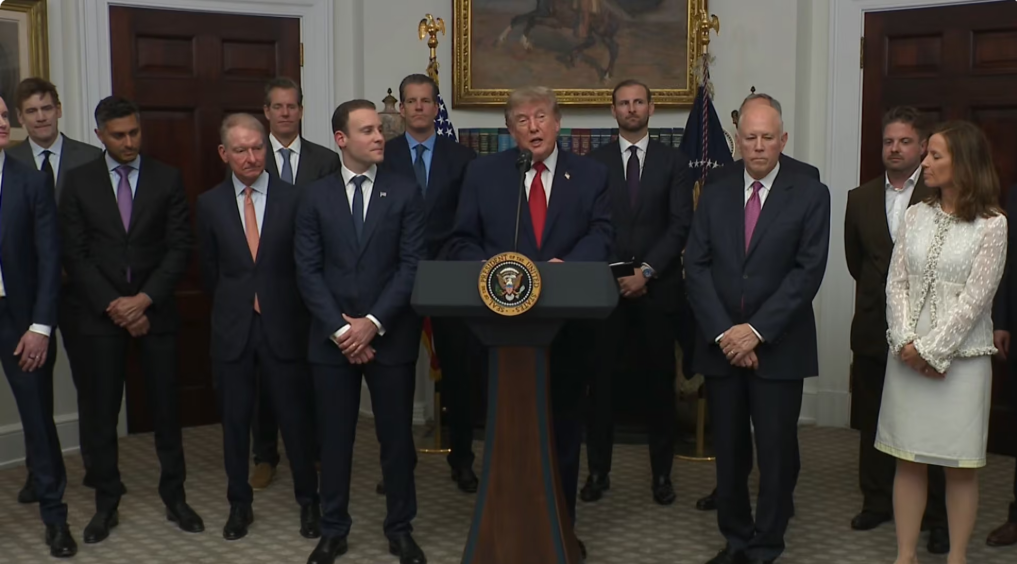
On August 19, Trump convened a meeting in the Roosevelt Room at the White House. Officially, it was the launch ceremony for the newly formed "Innovation Advisory Committee" (a think tank for the CFTC). Coinbase's Armstrong, Ripple's Garlinghouse, a16z's Chris Dixon—the room was packed with crypto heavyweights.
But what really made the market jump was a specific remark Trump made during the meeting.
He publicly called out CFTC Chairman Michael Selig, saying Selig was working hard to bring Hyperliquid, a crypto platform, into the U.S. market "in a fully compliant and legal way."
| A U.S. president personally saying he wants to open a legal door for an offshore exchange that has long operated outside U.S. regulation—that carries more weight for the entire on-chain finance space than any price surge.
For those in the know, the significance of that statement was immediately clear:
Hyperliquid previously didn't require KYC verification or anti-money laundering checks, so U.S. users could only access it via VPN. Now the president is personally saying "give it a proper license"—effectively drawing a clear compliance roadmap for the entire "decentralized derivatives" sector overnight.
The market reaction was almost unbelievably fast:
HYPE (Hyperliquid's platform token) jumped from $62 to $72.30, surging about 20% in a single day;
Hyperliquid Strategies (NASDAQ: PURR, a company that holds HYPE tokens so traditional stock investors can indirectly bet on Hyperliquid through a "digital asset treasury") saw its stock spike as much as 31% intraday, pushing its year-to-date gains to over 163%.
| An exchange founded by a Chinese entrepreneur, named by the U.S. president in person—its token up 20% and its listed affiliate up 30% the same day. That's the real star of this week.
The flip side is just as telling: traditional exchange stocks all fell that day. Cboe dropped 6.1%, and CME (Chicago Mercantile Exchange) fell 3.4%.
The logic isn't hard to follow—when an on-chain exchange is officially welcomed into the system, who panics first? The old money that lives off licenses and exchange monopolies.
We've covered this company before
If you've been followingYuanshang Observer, seeing "Hyperliquid" and "Jeff Yan" should bring a knowing smile.
In late July, we published a piece titled "A Young Chinese Founder and 11 People Are Building a '24-Hour Global Stock Exchange'"—that was about this very company. If you missed it, it's worth going back to read.
Here's a quick refresher:
Founder Jeff Yan, a Chinese entrepreneur, Harvard graduate, and former quantitative trader at high-frequency trading giant Hudson River Trading;
A team of 11 people, zero external funding—not a cent from venture capital—generating $900 million in profit in a single year, with $4 trillion in cumulative trading volume over three years since launch;
Focused on "perpetual contracts"—letting you bet on any asset going up or down without actually owning it, with no expiration date;
Since October last year, anyone can create new trading instruments on the platform—silver, crude oil, S&P 500, Tesla—all brought on-chain.
Back then, we marveled at "a young Chinese founder leading a team to build a global exchange." Less than a month later, this story took a massive leap forward—it was personally named by the U.S. president and invited into the American establishment.
What does that mean? It means our analysis was validated by reality in the fastest way possible.
In plain terms, three takeaways
First, this rally was just the "prelude"; Hyperliquid is the "main event." No matter how much Bitcoin and Ethereum surged, they were essentially setting the stage. What's truly reshaping the landscape is an exchange founded by a Chinese entrepreneur being named by the U.S. president for the first time, with a call to "legally bring it in." That's a historic signal, not just another price swing.
Second, the "legalization of on-chain trading" is accelerating. The U.S. is approving derivative products like perpetual contracts, and traditional exchanges are starting to lower their guard and talk to crypto teams about listings and partnerships. Going forward, what you can buy on compliant apps will increasingly shift from "buying stocks" to "betting on ups and downs with leverage."
Third, the real significance for ordinary people isn't "can I catch the bottom"—it's that "the rules are being rewritten." Between a Chinese 11-person team building an exchange and a U.S. president personally inviting it into the fold lies the handoff of the entire financial infrastructure.
As for what ordinary people should do, here are some honest words of caution—
Always use legal and compliant channels. In mainland China, trading and speculating in virtual currencies is strictly restricted. Don't resort to VPNs or other workarounds to bypass regulation in pursuit of returns, and don't touch offshore platforms with no licenses, no KYC, and unclear origins—that's not just a legal risk; it could be a scam that wipes out your principal overnight.
Leverage is a double-edged sword. Products that let you "bet on ups and downs with leverage and no expiration" amplify gains but also multiply losses. Ordinary people's capital can't survive many liquidations. Don't use borrowed money or money you need for living expenses. If you really want to explore such assets, first check the laws and regulations in your region, choose licensed, regulated products, use only spare cash, and manage your risk carefully.
We cover this space not to tell you to trade crypto, but because it's about "where money will flow next." Understanding the trend matters far more than chasing rallies or panic-selling.
This piece is one part of a series. First came "11 People Building a Global Exchange," and now we have "Trump's One Sentence Ignites Hyperliquid." We'll keep following this thread.
References
Core facts verified from the following sources (prioritizing English primary/mainstream financial outlets):
Reuters — August 19 White House CFTC Innovation Advisory Committee launch, Trump naming Hyperliquid and his "compliant and legal introduction to the U.S." remarks
Straits Times — Trump's remarks at the meeting, Hyperliquid Strategies (PURR) stock up to +31% intraday, 163% year-to-date gain
CNBC — HYPE token gains (approx. 16-20%), market reaction, Ethereum's ~19% 7-day gain
CoinDesk — Bitcoin at $69,000-$70,000, Ethereum +18.2% in a day to $2,258, $1.4B in short liquidations, crypto market cap +$110B in 20 minutes
Standard Chartered Research — Bitcoin year-end target of $100,000
Related prior piece: "A Young Chinese Founder and 11 People Are Building a '24-Hour Global Stock Exchange'"(Yuanshang Observer, 2026-07-29)
All figures are intraday data from that day; actual results may vary. The analysis in this article does not constitute investment advice. Please refer to the laws and regulations of your region.
See higher, walk farther