Good evening, crypto princes and princesses! Your editor is still up burning the midnight oil watching the charts. Driven by news headlines, volatility across the risk market has picked up—visible in BTC, ETH, and gold alike.
At 8:30 PM Beijing time tonight, the Fed's most critical data point—core PCE—was released. Although both July CPI and PPI came in lower, core PCE showed little change, matching expectations at 3.3%, the same as last month. 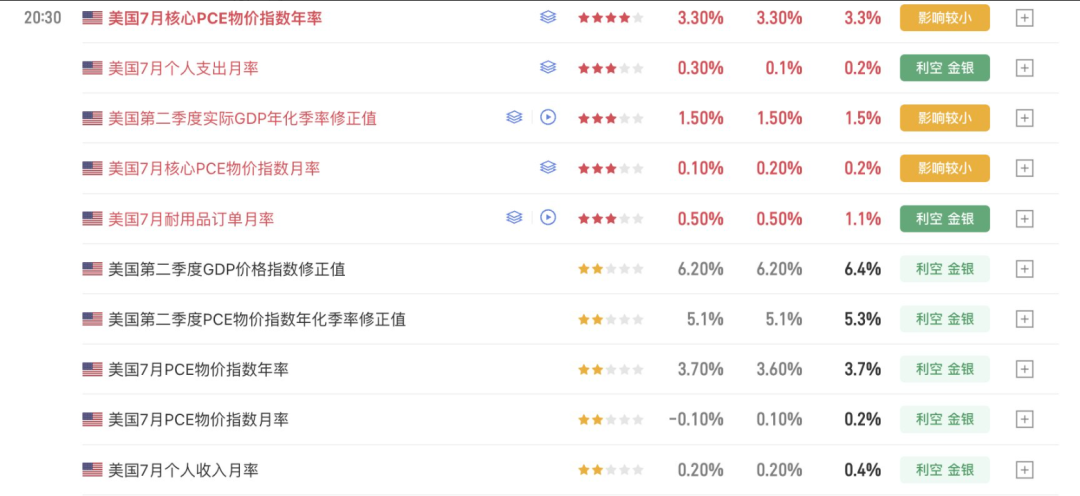
While this isn't exactly great news for the market—investors were hoping to see inflation decline—at least meeting expectations doesn't raise the odds of a Fed rate hike. Market pricing for a September hike has already dropped notably from earlier levels, now sitting at just 38%. The market seems to accept the current inflation data. The Fed's concern is no longer about inflation spiraling out of control, but rather about it getting stuck above 3% and refusing to come down. In the July meeting minutes, several officials already expressed support for further hikes, and many believed that if inflation doesn't continue falling toward 2%, more tightening would be needed. Just the day before yesterday, Boston Fed President Collins publicly reiterated that if upcoming data fails to show continued disinflation, the Fed may need to raise rates soon. So overall, core PCE at 3.3% is broadly in line with expectations, and the market is unlikely to react dramatically. However, if inflation continues to rise from here, the market could still face some pain. Moreover, this data point is unlikely to change the fact that August inflation may tick up, mainly due to oil. Even though crude prices have started to retreat recently, the average U.S. regular gasoline price in August so far is still about 3% higher than in July. The Cleveland Fed's forecast also highlights this issue, projecting overall PCE at roughly 3.65% year-over-year for July, only to climb back to 3.73% in August. Core PCE is expected to edge up slightly from 3.29% in July to 3.34%. So if the Strait of Hormuz gradually resumes passage for non-hostile nations and Persian Gulf oil supplies continue to recover, the probability of oil and U.S. gasoline prices falling further in September would increase significantly. At that point, the Fed's inflation pressure might finally begin to ease. If not, September could really spell trouble. For the outlook ahead: your editor leans toward rebuilding a long position in ETH.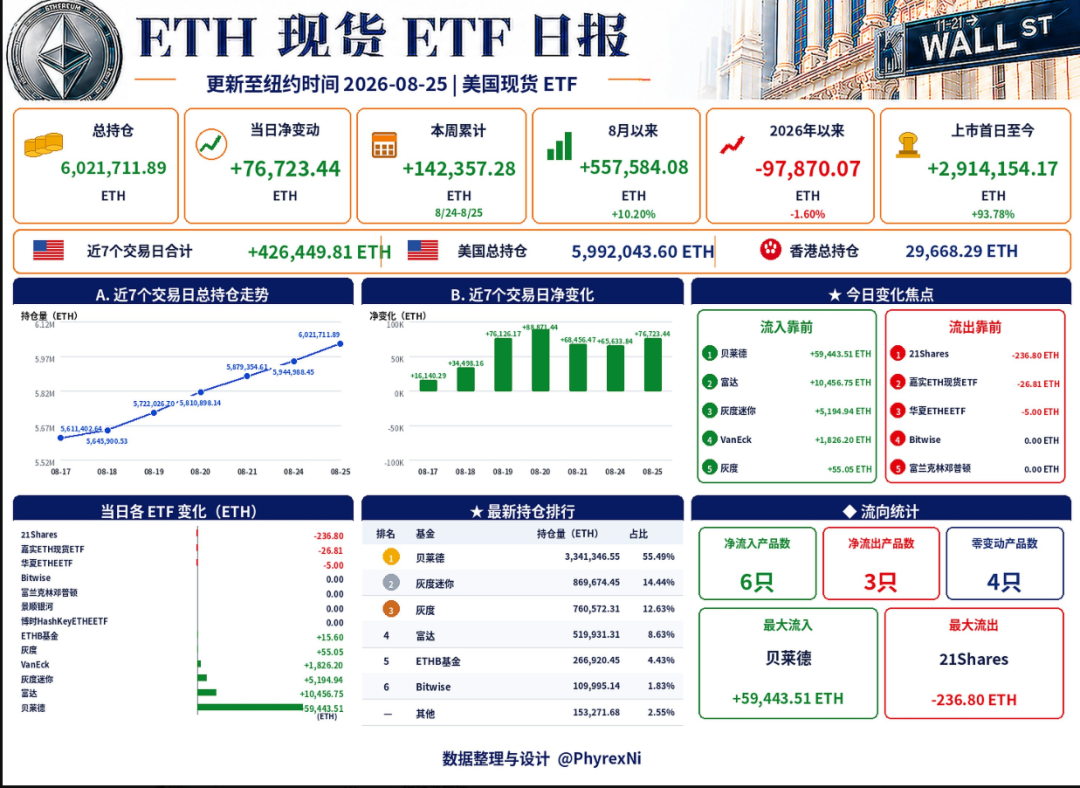
On August 25, total holdings in ETH spot ETFs surpassed 6 million ETH for the first time, reaching 6,021,711.89 ETH, with a net addition of 76,723.44 ETH that day. This marks the 8th consecutive trading day of net inflows for ETH ETFs, and the single-day inflow on August 25 was even larger than the roughly 65,600 ETH seen on August 24.
Since the start of August, cumulative net inflows into ETH ETFs have reached 557,584.08 ETH, with total holdings up about 10.20% from the beginning of the month. In other words, just in August, ETH ETF holdings have grown by over 10%, a pace that continues to outpace BTC's 3.44% over the same period.
Cumulative outflows since the start of 2026 have narrowed to 97,870.07 ETH, now only about 1.60% below the peak. As of August 14, year-to-date outflows still exceeded 520,000 ETH, but after eight consecutive days of inflows, the remaining gap to fully recover this year's holdings deficit is now less than 100,000 ETH. If this pace of inflows continues for a few more sessions, year-to-date holdings could easily swing back into positive territory.
At present, ETH's capital inflow strength remains clearly higher than BTC's. BTC has seen inflows for 7 consecutive days, while ETH has logged 8 straight days, with cumulative additions of over 426,000 ETH in the last 7 days and August holdings growth already surpassing 10%. If the current pace of tens of thousands of ETH in net inflows per day persists, the year-to-date holdings gap could be fully closed very soon.
Today's wealth code: Long Eth!