
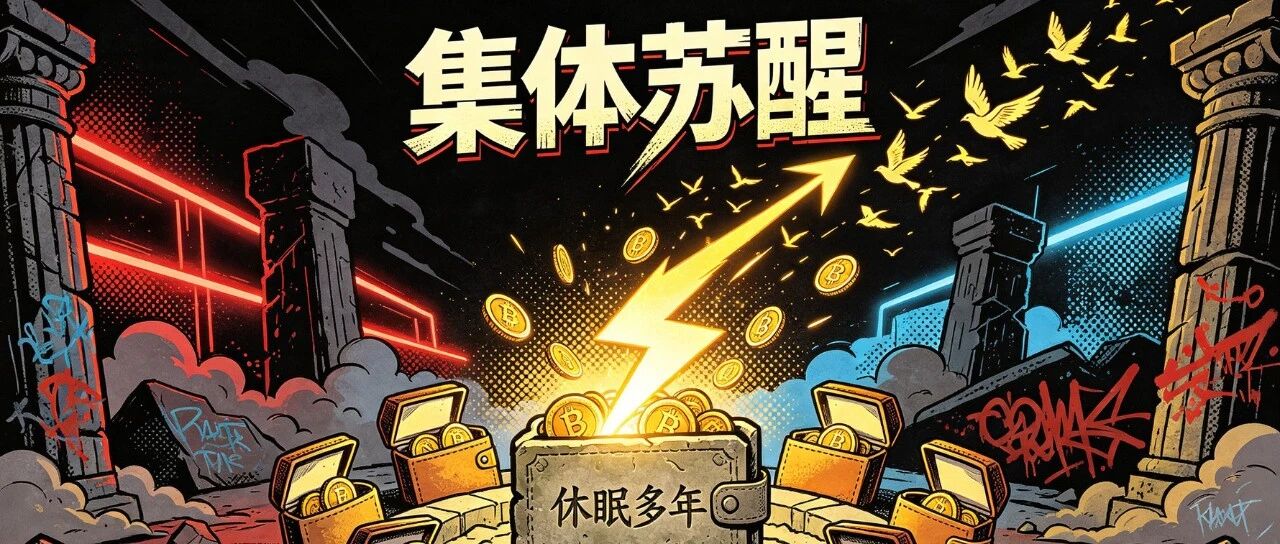
Something quite rare has been happening on-chain recently.
Six Bitcoin wallets that had been dormant for over a decade suddenly came back to life between August 16 and 26, collectively moving 553.59 BTC. At the time, that was worth approximately $40.15 million.
Fifteen years of silence.
These six wallets are all quite old. The earliest one had not been touched since June 2011—a full 15.1 years of dormancy. What was Bitcoin's price back in 2011? Around $14 per coin. From $14 to the $538,000 price at the time of transfer, that's a return of over 460,000 times.
Another wallet, dormant since August 2012, moved 212 BTC in one go, worth about $13.66 million. A wallet from December 2014 transferred 150 BTC. The most recent transfer was 40 BTC, which went to Boerse Stuttgart Digital, a German regulated custodian.
These addresses share a common trait: from creation to this transfer, over a decade passed with no on-chain activity whatsoever. They weathered Bitcoin's entire journey from a few hundred dollars to over a hundred thousand, never selling at the peak, never moving during the crashes. Then, in August 2026, six of them woke up almost simultaneously.
Two driving forces.
This kind of collective awakening of "ancient wallets" is rare in Bitcoin's history. On-chain analysts generally believe two main factors are behind this concentrated movement.
The first is a security vulnerability in Coldcard hardware wallets.
In late July 2026, Coldcard was exposed for a serious flaw. The issue traced back to a firmware update in March 2021, where a coding error bypassed the hardware random number generator, replacing the 128-bit high-entropy random seed that should have been generated by hardware with weak software-generated randomness. This meant that private keys generated with the affected firmware had far less actual entropy than designed, allowing attackers to crack them through computational power.
The consequences were devastating. Galaxy Research tracked that, as of August 25, 8,865 addresses and 1,789.28 BTC had been stolen, worth approximately $114.7 million. The first wave of attacks hit on July 30, draining 1,082.65 BTC from 1,196 addresses in just 41 minutes. Multiple subsequent waves followed.
TRM Labs called it the largest hardware wallet security incident on record. A brand that had been making hardware wallets for over a decade hit a fatal flaw in its firmware. This isn't just a Coldcard user problem—it shook the entire trust foundation of hardware wallets. Long-term holders began to question whether their "secure" devices were truly secure, and moving assets became a risk-aversion move.
The second driver is a massive lawsuit in New York targeting dormant addresses.
In May 2026, a plaintiff using the pseudonym Noah Doe filed a lawsuit in the New York State Supreme Court, claiming ownership of 39,069 long-dormant Bitcoin addresses, which collectively hold about 3.7 million BTC, worth roughly $234 billion. This includes 21,744 addresses allegedly belonging to Satoshi Nakamoto, holding about 1.09 million BTC.
The plaintiff invoked New York's "abandoned property law," seeking to declare these long-unused Bitcoin addresses as unclaimed property. To serve notice to thousands of wallets, the plaintiff used an unusual tactic: sending dust transactions to these addresses.
Among the six wallets that woke up this time, two carry the "Salomon Client Dusted" label, directly linked to this lawsuit. One wallet that moved 212 BTC is tagged "Noah Doe #1396".
This lawsuit has raised a real concern: long-inactive Bitcoin addresses could face legal ownership challenges. If the court rules in the plaintiff's favor, assets in dormant addresses could be deemed unclaimed property. For early holders, activating addresses, moving assets, and re-establishing control has become a necessary step to avoid legal risk.
A broader trend.
The transfer of 553 BTC itself isn't a big deal, but the trend it reflects is worth noting.
Since August 2026, activity among dormant Bitcoin has been climbing. On August 19-20, 28 long-dormant wallets collectively moved 1,314.41 BTC. Around August 5, wallets dormant for over 12 years were also activated. Counting this 553 BTC, August's dormant Bitcoin migration volume is on track to hit an all-time high.
These migrations share a common feature: most funds did not flow to exchanges. Of the 553 BTC, the majority moved between different on-chain addresses, typical of wallet restructuring or asset migration. A small portion went to regulated custodians. This isn't a sell signal—it looks more like repositioning assets.
Early Bitcoin holders are doing one thing: moving assets stored in old addresses to safer places. The combination of security threats and legal risks has forced these "ancient coins," silent for over a decade, to surface.
When these Bitcoins were mined over a decade ago, they might have been just small amounts casually stored by tech enthusiasts. Now they're worth tens of millions of dollars and have become assets that demand serious attention. The holder's identity, control of the address, and regulatory compliance—each issue could invite unwanted trouble.
On-chain data is transparent. When you move, others see it. When seen, you can be tracked. When tracked, you can be questioned. For early players who value privacy, this transparency itself is a risk. And the Coldcard vulnerability and the New York lawsuit have amplified that risk.
The transfer of 553 BTC is not the end. There are still countless addresses on-chain that have been dormant for over a decade. The holders of these wallets may be facing the same choice: stay silent, or step into the light.
Silence carries its own risks; appearing has its own costs. Behind every choice lies a trade-off.
👇👇👇
Note: If you'd like to join our community for discussions, feel free to follow this official account! You'll find a QR code for the group in the account. We'll share trend analysis, macro insights, on-chain data, news updates, live market commentary, and long/short strategies.